Category Archives: Europe

The Origins and Age of Popes

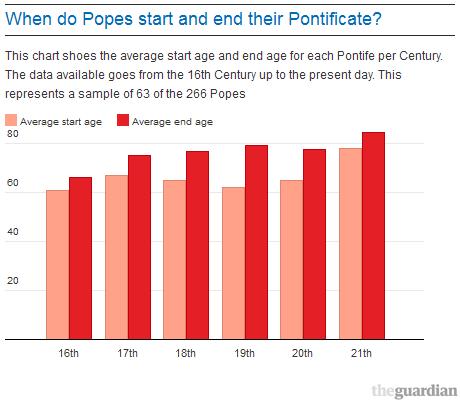
In the light of Pope Benedict XVI’s resignation last week, The Guardian created different visualizations related to the papacy. The reign of each Pontiff is usually due to death. The last one to resign was Gregory XII in 1415.

According to the graph shown above, 65 is the most common age at which Popes are elected, and 78 is the most common age at which they die. The Guardian used a sample of 63 Popes out of 266 to compute these numbers.
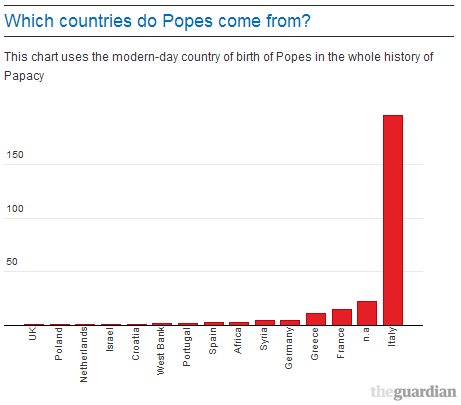
Of all 266 Popes, 196 came from Italy (74%). The origin cannot be traced for 22 Popes (8%). 15 Popes came from France (6%), 11 from Greece (4%), 5 from Germany, 5 from Syria, 3 from Africa, 3 from Spain, 2 from Portugal, and 2 from the West Bank. Countries from which only one Pope came from include: Croatia, Israel, Netherlands, Poland, and the UK.
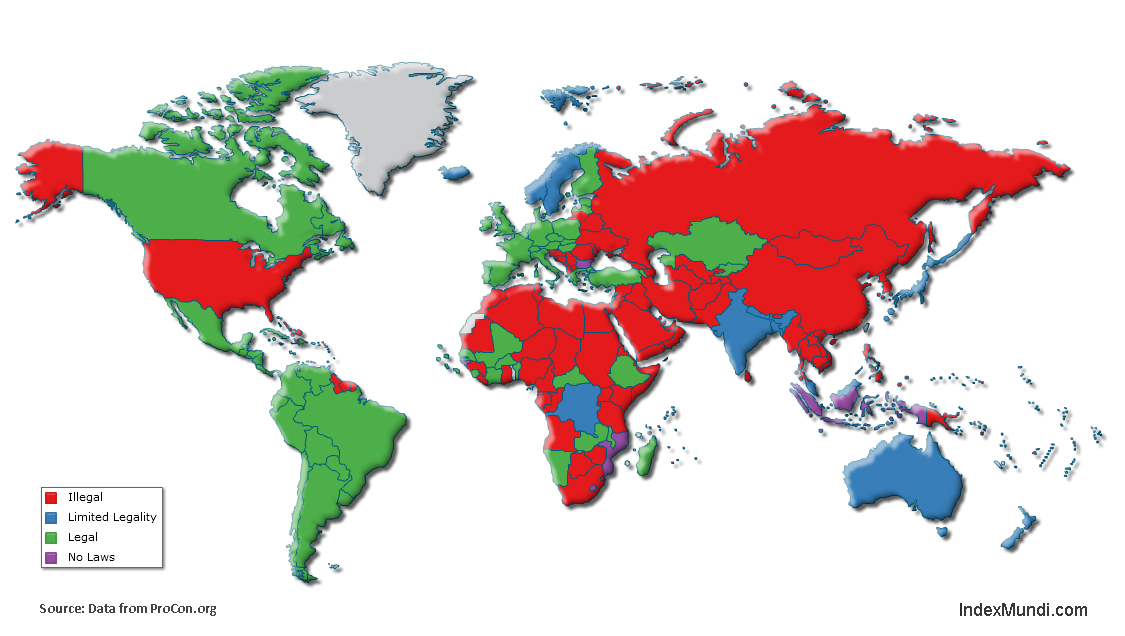
 

Prostitution Policy by Country

click to enlarge

Prostitution is defined as the practice of providing sexual services to another individual in exchange for payment.

The legal status of prostitution varies from country to country. In some countries the practice is legal and regulated like in the case of Germany, Brazil, Netherlands, Canada, Argentina, Indonesia and Singapore, to name a few. In others it is illegal, with extreme cases where it is punishable by death. In the United States prostitution is illegal, except for 11 counties in the state of Nevada. As seen in the map above, it is illegal in most countries.

Some countries have a limited legality policy such as in the case of Australia, where prostitution is legal in most of the country, except in Southern Australia where its practice is restricted. Other countries with limited legality include Bangladesh, Democratic Republic of the Congo, Iceland, India, Japan, Malaysia, Nepal, New Zealand, Norway and Sweden.

There are no laws regarding prostitution in countries like Bulgaria, Guinea-Bissau, Indonesia, Lesotho and Mozambique.

For more details visit: ProCon.org: 100 Countries and Their Prostitution Policies


Countries With the Largest Gold Reserves

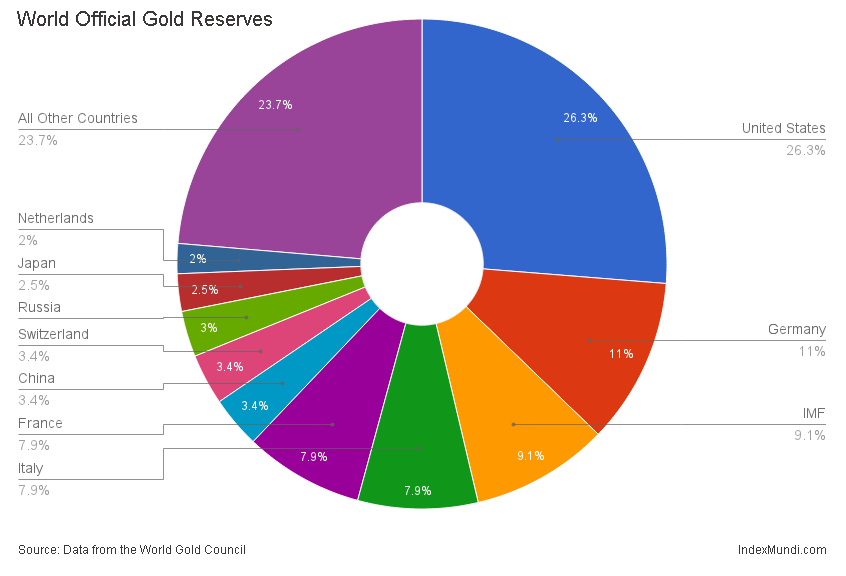
According to a World Gold Council report, world official gold reserves are estimated to be 31,575 tonnes as of January 2013. The United States ranks number one in official gold holdings with 8,133 tonnes. It is followed by Germany, the IMF (International Monetary Fund), Italy, France, China, Switzerland, Russia, Japan and the Netherlands. All other countries combined hold 7,325.5 tonnes in gold reserves. The countries in that group include India, Taiwan, Portugal, Venezuela, Saudi Arabia and Turkey. The Euro area holds 10,783 tonnes in gold reserves.

Resource Investor reports that central banks increased their official gold holdings to 500 tonnes in 2012 from 465 tonnes in 2011.

Resources:


We Live Longer

click to enlarge

Average global life expectancy is now 70.4 years; 73.3 for women and 67.5 for men.

Life expectancy has gone up significantly in places like Iran, Bangladesh, the Maldives, South America and Africa, where the increase has been of 13 years or more, compared to previous decades. North America, Western Europe and Australasia have seen a modest increase of 7 plus years.

The rise in life expectancy has been possible thanks to the improvement in health programs and the control/cure of many infectious diseases that ended up in death, especially in young children.

But, there are places where the rise has been negligible like Eastern Europe, with an average increase of just 1 year. Other places have even experienced a decline in life expectancy. Such is the case of Lesotho and Belarus, which have seen a rise in HIV and alcoholism, respectively.

According to a report published by The Lancet, although we live longer now, the quality of life has declined due to the rise in obesity and its consequences: diabetes, high blood pressure and heart conditions.

Resources:


Gun Ownership Worldwide

click to enlarge

Using data from the United Nations Office on Drugs and Crime (UNODC) on homicides by firearms worldwide, we can see that the United States has the highest average of gun ownership, 88.8 per 100 people. The U.S. is followed by Yemen with 54.8 average per 100 people, Switzerland with 45.7, and Finland with 45.3 average per 100 people. Although, these countries rate at the top in gun ownership, their numbers are much lower compared to the U.S.

According to this data, countries with the lowest gun ownership include: Tunisia, East Timor, Ethiopia, Ghana, Bangladesh, Eritrea, Fiji, among others.

For more information visit:


The Cheapest and Most Expensive Places to Fill Your Gas Tank

click to enlarge

Gas prices go up or down according to supply-demand forces and to movements in the commodities market. According to this map, published by the Car and Driver blog, prices in the United States ($3.85 per gallon) are not that bad compared to gas prices in other countries.

European nations have the highest gas prices, above $7 per gallon. If you were in Turkey you will have to pay the highest price, a steep $9.39 per gallon. Turkey’s gas prices are followed by Norway ($9.38), Italy ( $9.00), Sweden ($8.75), the United Kingdom ($8.46), Germany ($8.29), and Iceland ($8.01).

In the Americas, the highest gas prices can be found in Belize ($7.59), followed by Uruguay ($6.99), Chile($6.60), Peru ($5.95), Argentina ($5.52) and Canada ($5.14). Gas prices are significantly low in Venezuela ($0.06) and Bolivia ($2.05) due to government subsidies.

Africa enjoys low gas prices, except for Djibouti ($6.48), Madagascar ($5.74), Zimbabwe ($5.38), and South Africa ($5.15).

In Asia, Japan pays the highest gas prices, $6.87 per gallon, followed by the Philippines ($5.43), and India ($5.42).

In Australia, New Zealand and Australia’s gas prices per gallon are $6.75 and $5.64, respectively.


The Best and Worst Places to be Born in 2013

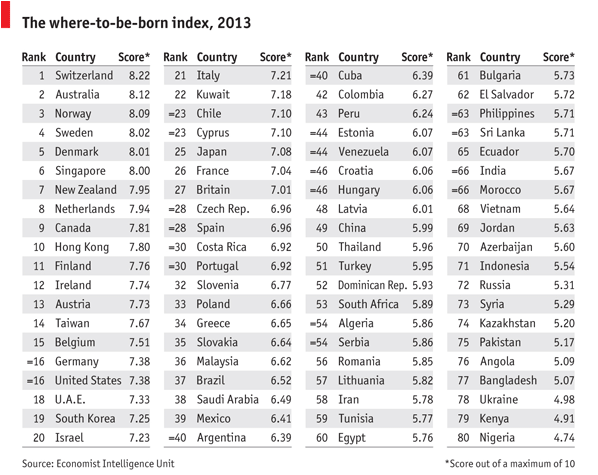
Back in 1988, the United States was ranked first as the best country to be born. Twenty five years later, the U.S. is ranked number 16.

The Economist Intelligence Unit compiled the where-to-be-born index which measures which country will provide the best opportunities to someone born in 2013. It links the results of life satisfaction surveys to indicators that affect the quality of life in those countries, such as geography, demographics, culture, government policies, the economy, etc.

Based on those factors, the best places to be born are Switzerland, Australia followed by Norway, Sweden Denmark, and Singapore. At the bottom of the list you will find Nigeria, Kenya, Ukraine, Bangladesh, Angola, Pakistan, among others.


The Global Public Debt Clock is Ticking

click to enlarge

Global public debt is increasing every second. This debt clock shows government debt, in dollar terms, for almost all countries. Governments with the highest debt include the United States, Canada, Brazil, Australia, India, China, and several western European nations.

Additional indicators such as public debt per person, public debt as percentage of GDP, total annual debt change, and country debt comparisons can be seen in the interactive map at: The Economist: The global debt clock


United Kingdom Facts

United Kingdom Facts

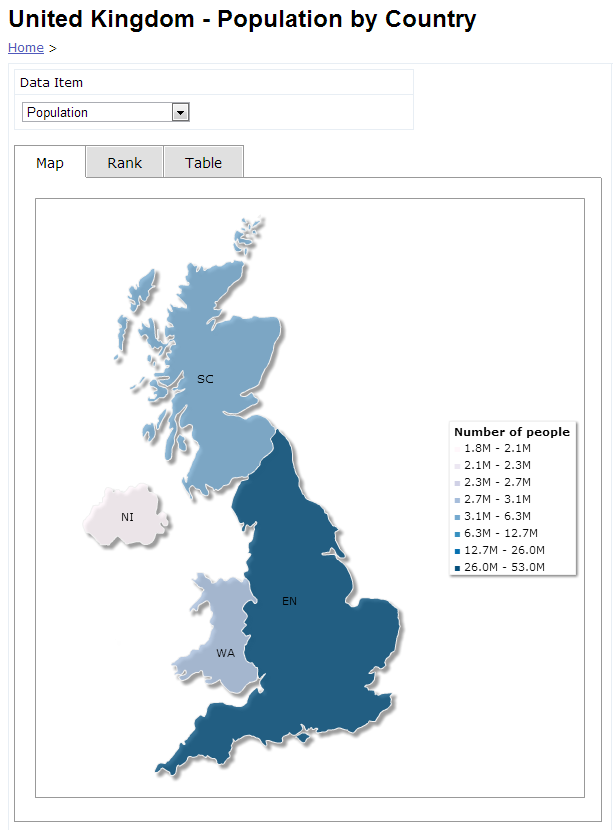
We just launched a new section with facts about the United Kingdom, its countries, and regions. We started with basic population indicators; we’ll be adding additional indicators over the coming weeks. Click on the following links to explore the thematic maps, ranking charts, and data tables we have so far:

Youth Unemployment in Europe and the US

Youth unemployment in Europe and the US

A new report from Eurostat shows that the economic crisis in Europe is creating rising unemployment throughout the continent. The 25 years old and under age group has been the hardest hit by a wave of layoffs and by the reluctance of firms to hire. In Greece and Spain, youth unemployment has risen above 50%, a level which has been fueling mass protests and even violence. Check the article at The Atlantic for a more detailed discussion about the graph above.