Author Archives: Miguel Barrientos

Internet traffic from Libya

I thought it would be interesting to share a snapshot of our traffic graphs to show how Internet access to our site has been affected during the uprisings in the Middle East. Let’s start with a graph showing visits from Tripoli, the capital of Libya.
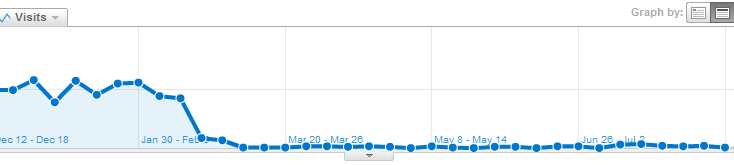
Tripoli City Detail- - Google Analytics

The graph above shows that access to the Internet in Tripoli has been virtually non-existent since February. It will be interesting to see how fast traffic recovers once it gets restored.

Contrast the graph above to the traffic chart for Cairo (Egypt):

Cairo City Detail- - Google Analytics

As shown above, visits from Cairo dipped considerably for a few days at the end of January / beginning of February, but it recovered fairly quickly once Mubarak stepped down.

The final graph I wanted to share is for Tunis, the capital of Tunisia:
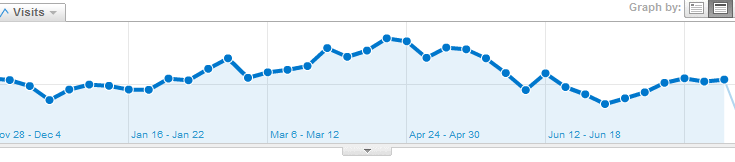
Tunis City Detail- - Google Analytics

It is remarkable that visits from Tunis were largely unaffected despite the turmoil that started in December 2010 and continued until the ouster of President Ben Ali on January 14th, 2011.
Visualizing Commodity Trading

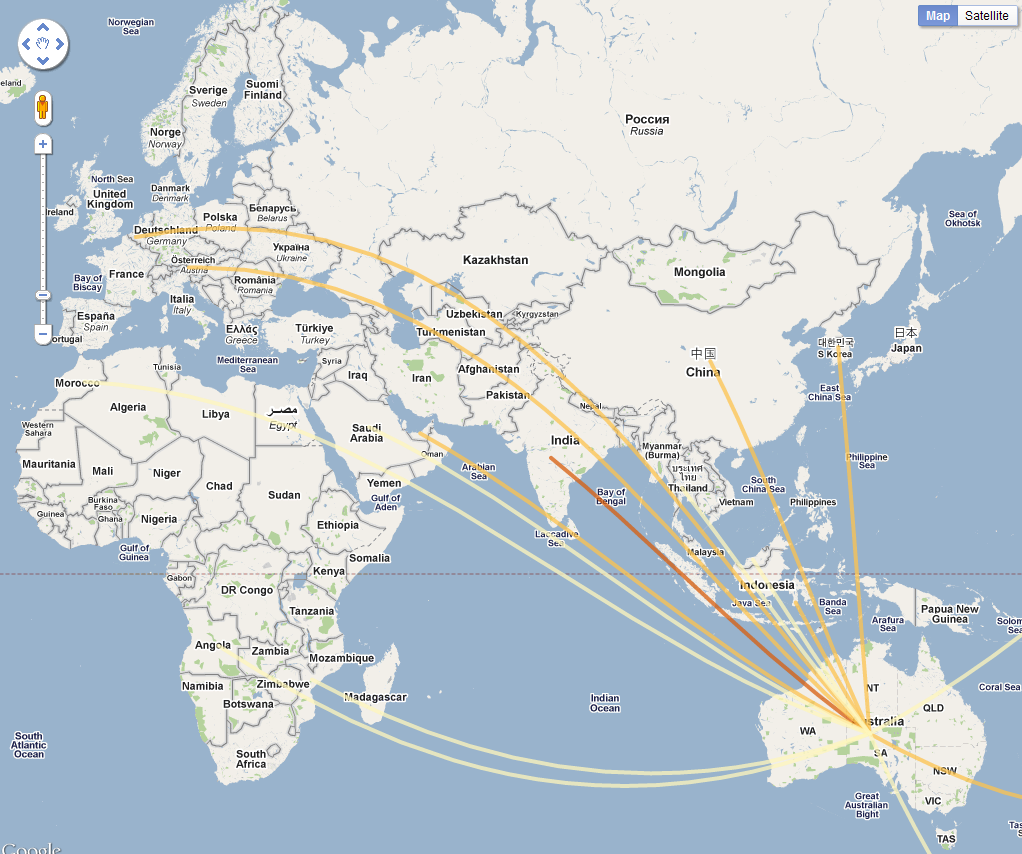
We are currently processing the results of our commodities trade survey. We figured that a good way to display the results would be through a map visualization showing trade flows to and from each country represented in the survey. The image below shows one of the visualizations (click on it for a larger version).

commodities trade flows from Australia

The map shows trade flows from Australia. Lighter lines represent trade flows with a small number of deals. Darker lines are used for trade flows with larger number of deals. Stay tuned for more results.

Update (August 15th, 2011): You can now play with our trade flow visualizations.

Tax Revenue Per Capita

Today we improved our US state tax revenues section by adding a new variable: tax revenue per capita. Check out the map below for an example showing tax revenue per capita for tobacco products:

New Hampshire collects the most taxes on a per capita basis than any other state. Now we will have to look for data showing if high taxes on tobacco products result in lower numbers of smokers.

Operating System Market Share

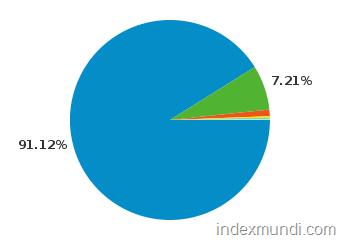
One of the side benefits of running a highly trafficked global site is that we can analyze and confirm changes in the market share of PC operating systems. Here is a graph showing OS market share for the past 30 days:


OS market share 2010

The large blue slice of the pie chart corresponds to all Microsoft operating systems, while the small green slice corresponds to all Macintosh operating systems.

Contrast the graph above with a similar one for the same period in 2009:


OS market share 2009

If our visitors are representative of the overall universe of web users, it looks like Microsoft has lost significant market share to Apple.

North Carolina Sales Tax Revenue

Continuing with our series of posts about our new state tax revenue section, I highlight the case of sales tax revenue for North Carolina. Unlike many other states, sales tax revenue has increased significantly despite the economic downturn, as shown in the graph below.

In fact, sales tax revenue hit a high of $1.5 Billion in Q2 2010. It should be noted that the NC sales tax rate was increased temporarily by an additional 1% as of September 2009. The increase will expire on July 1, 2011.

California sales tax revenue history

Our new state tax revenue section makes it easy to view the effects of the current economic downturn on state tax revenues. Take for example the case of California. As shown in the graph below, revenue from sales taxes hit a peak of $9.5 Billion in Q4 2007 and a recent low of $7.3 Billion in Q1 2009. The amount collected for Q2 2010 (which is the most recent amount reported to the US Census Bureau) was $9.1 Billion, which some would argue is clear proof that the economy is recovering, while others say that it is just a temporary increase due to temporary government stimulus.

Source: US Census Bureau

Official US Holidays 2011

Federal law (5 U.S.C. 6103) establishes the following public holidays for Federal employees. Please note that most Federal employees work on a Monday through Friday schedule. For these employees, when a holiday falls on a non-workday — Saturday or Sunday — the holiday usually is observed on Monday (if the holiday falls on Sunday) or Friday (if the holiday falls on Saturday).

Friday, December 31, 2010* New Year’s Day
Monday, January 17 Birthday of Martin Luther King, Jr.
Monday, February 21** Washington’s Birthday
Monday, May 30 Memorial Day
Monday, July 4 Independence Day
Monday, September 5 Labor Day
Monday, October 10 Columbus Day
Friday, November 11 Veterans Day
Thursday, November 24 Thanksgiving Day
Monday, December 26*** Christmas Day

* January 1, 2011 (the legal public holiday for New Year’s Day), falls on a Saturday. For most Federal employees, Friday, December 31, 2010, will be treated as a holiday for pay and leave purposes. (See 5 U.S.C. 6103(b).)

** This holiday is designated as "Washington’s Birthday" in section 6103(a) of title 5 of the United States Code, which is the law that specifies holidays for Federal employees. Though other institutions such as state and local governments and private businesses may use other names, it is our policy to always refer to holidays by the names designated in the law.

*** December 25, 2011 (the legal public holiday for Christmas Day), falls on a Sunday. For most Federal employees, Monday, December 26, will be treated as a holiday for pay and leave purposes. (See section 3(a) of Executive order 11582, February 11, 1971.)

Source: United States Office of Personnel Management