The Cheapest and Most Expensive Places to Fill Your Gas Tank

click to enlarge

Gas prices go up or down according to supply-demand forces and to movements in the commodities market. According to this map, published by the Car and Driver blog, prices in the United States ($3.85 per gallon) are not that bad compared to gas prices in other countries.

European nations have the highest gas prices, above $7 per gallon. If you were in Turkey you will have to pay the highest price, a steep $9.39 per gallon. Turkey’s gas prices are followed by Norway ($9.38), Italy ( $9.00), Sweden ($8.75), the United Kingdom ($8.46), Germany ($8.29), and Iceland ($8.01).

In the Americas, the highest gas prices can be found in Belize ($7.59), followed by Uruguay ($6.99), Chile($6.60), Peru ($5.95), Argentina ($5.52) and Canada ($5.14). Gas prices are significantly low in Venezuela ($0.06) and Bolivia ($2.05) due to government subsidies.

Africa enjoys low gas prices, except for Djibouti ($6.48), Madagascar ($5.74), Zimbabwe ($5.38), and South Africa ($5.15).

In Asia, Japan pays the highest gas prices, $6.87 per gallon, followed by the Philippines ($5.43), and India ($5.42).

In Australia, New Zealand and Australia’s gas prices per gallon are $6.75 and $5.64, respectively.
 

The United States of Walmart

click to enlarge

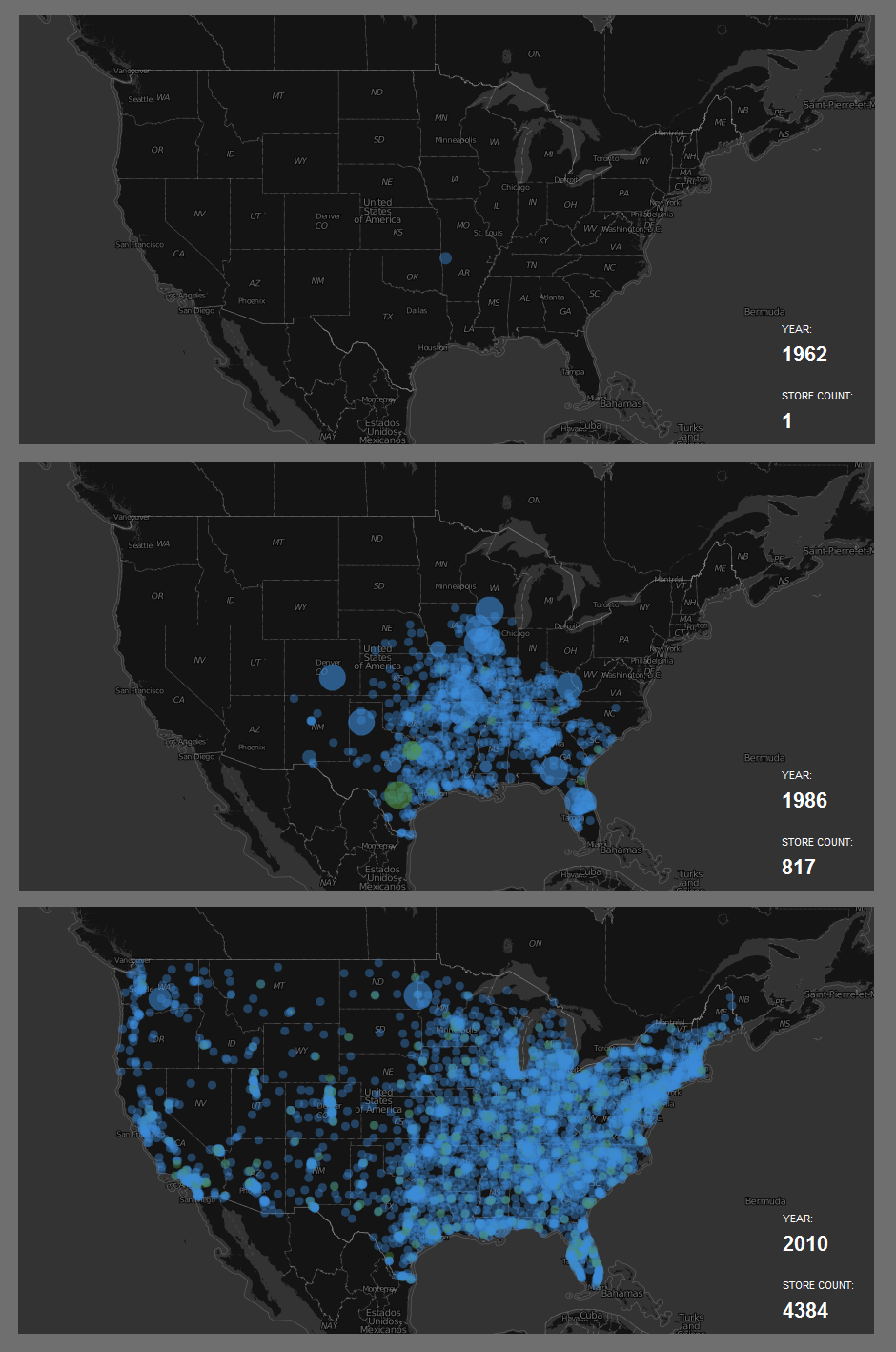
Walmart opened its first store in Rogers, Arkansas, back in 1962. From there it spread slowly through the South East. By 1986, twenty five years later, Walmart had 817 stores in the continental U.S. As of 2010, Walmart had 4,384 stores covering the entire country, including Hawaii, Alaska and Puerto Rico, but heavily concentrated in the East Coast and part of the Mid West.

Walmart is the world’s third largest public corporation, preceded only by Dutch Shell Company y Exxon Mobil.

For the interactive map, visit: Flowing Data: Watching the growth of Walmart


The Best and Worst Places to be Born in 2013

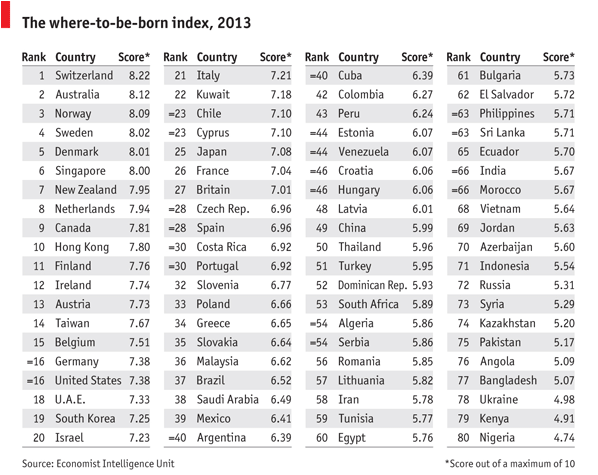
Back in 1988, the United States was ranked first as the best country to be born. Twenty five years later, the U.S. is ranked number 16.

The Economist Intelligence Unit compiled the where-to-be-born index which measures which country will provide the best opportunities to someone born in 2013. It links the results of life satisfaction surveys to indicators that affect the quality of life in those countries, such as geography, demographics, culture, government policies, the economy, etc.

Based on those factors, the best places to be born are Switzerland, Australia followed by Norway, Sweden Denmark, and Singapore. At the bottom of the list you will find Nigeria, Kenya, Ukraine, Bangladesh, Angola, Pakistan, among others.


Pope Benedict XVI is on Twitter

click to enlarge

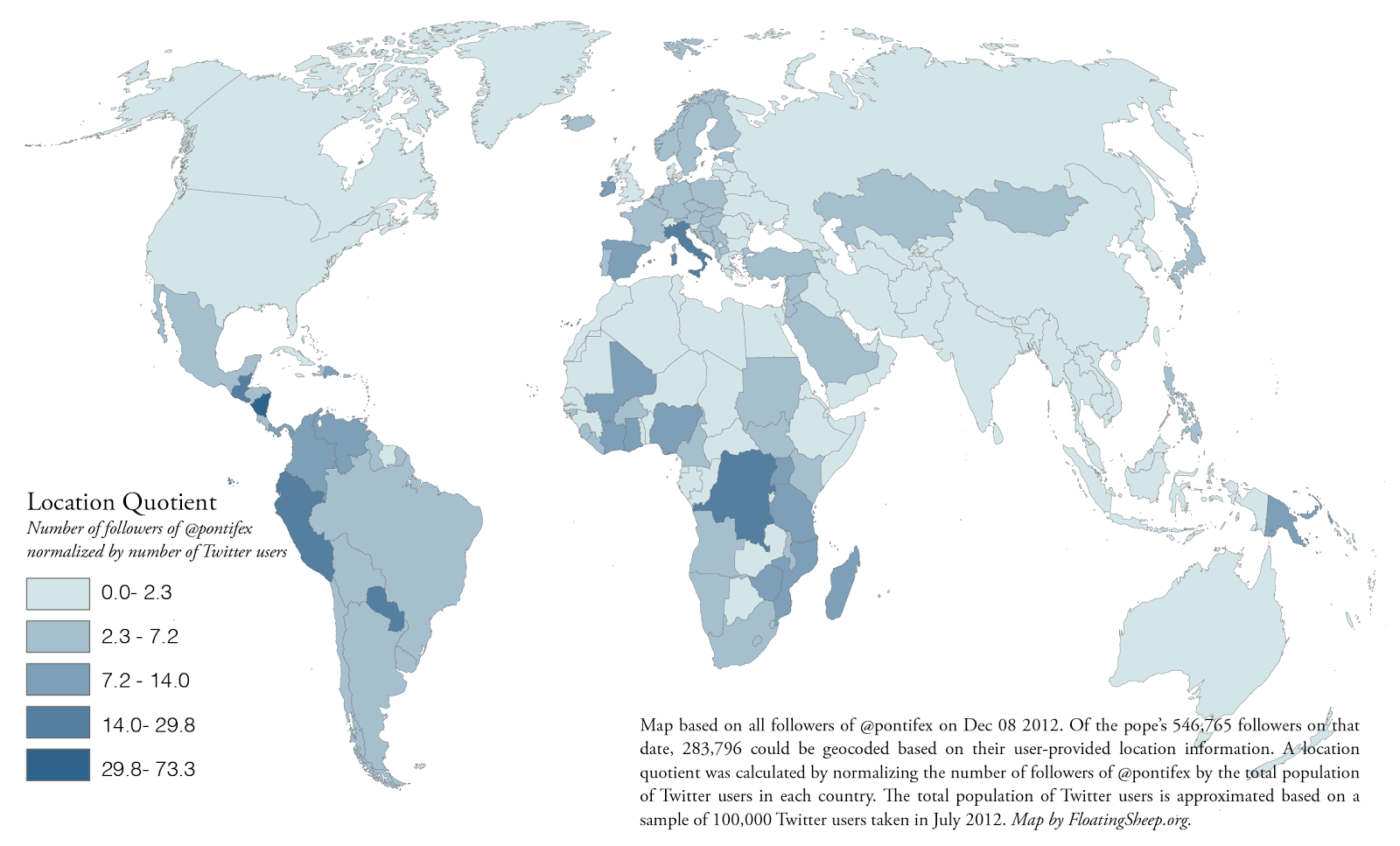
Pope Benedict XVI has Twitter presence beginning December, 2012. His English language account @Pontifex already has 1,342,380 followers from all around the world, and has sent 14 tweets. The Floating Sheep blog mapped followers of this account based on their location as of December 8, 2012. According to this map, the largest number of followers were located in Italy and Nicaragua, followed by the Democratic Republic of Congo, Guatemala, Peru, Ecuador, Paraguay, Spain and Ireland among others.


The Global Public Debt Clock is Ticking

click to enlarge

Global public debt is increasing every second. This debt clock shows government debt, in dollar terms, for almost all countries. Governments with the highest debt include the United States, Canada, Brazil, Australia, India, China, and several western European nations.

Additional indicators such as public debt per person, public debt as percentage of GDP, total annual debt change, and country debt comparisons can be seen in the interactive map at: The Economist: The global debt clock


Vulnerability to Climate Change

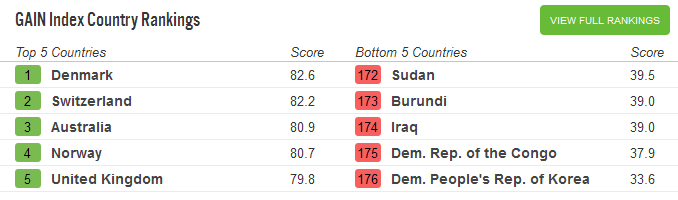
The Global Adaptation Institute (GAIN) created the GAIN Index to measure the vulnerability of countries to climate change, combined with how well prepared these countries are to face the global challenges associated with it.

Countries at extreme risk include North Korea, the Democratic Republic of Congo, Iraq, Burundi, Chad, Sudan and Zimbabwe. At the other end of the spectrum, countries with the lowest risk include Denmark, Australia, Switzerland, Norway, the UK, New Zealand, Norway, to name a few.

For a complete list of countries and index methodology visit: The Global Adaptation Institute: The GAIN Index


The World’s Deadliest Cities

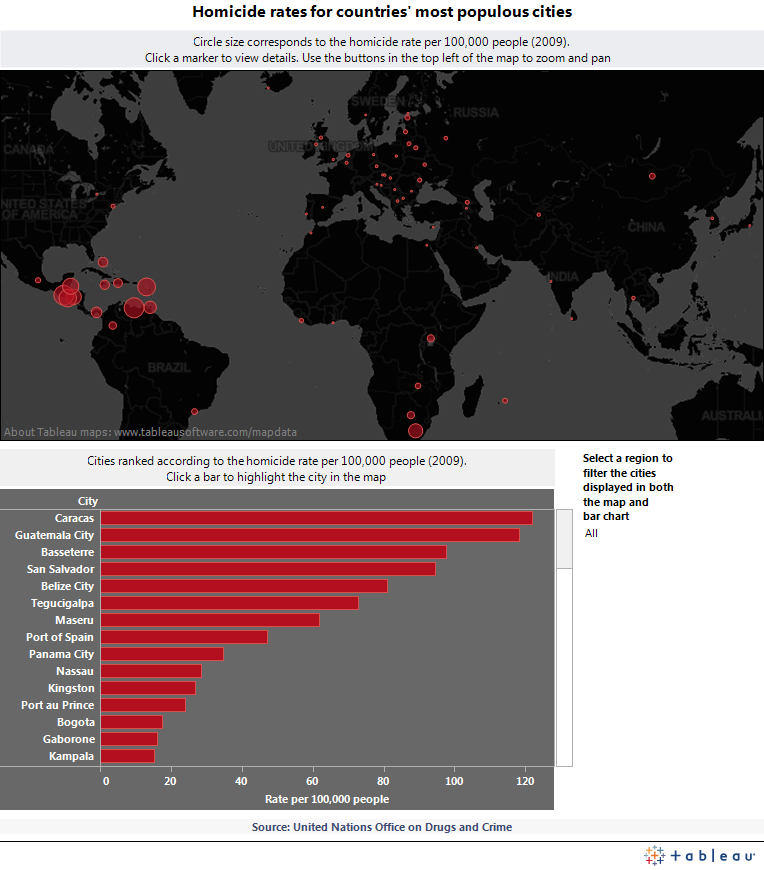
World's Deadliest Cities

The excellent data blog from The Guardian created an interactive visualization showing murder rates in the world’s most populous cities. The data, obtained from the UN, shows that Caracas, Guatemala City, and Basseterre have the highest homicide rates, while Lisbon, Ljubljana, and Tokyo have the lowest. You can read more details about their analysis in the accompanying article.

Rape Statistics by Country

click to enlarge

The UN Office on Drugs and Crime compiles rape statistics from countries around the world. We used their most recent numbers to create the map displayed above, which shows the number of rapes reported to police per 100,000 inhabitants. According to the UN data, the country with the highest rate of reported rapes is Botswana (92.9), while the country with the lowest rate is Egypt (0.1). Note though that comparison of crime rates across countries needs to be be taken with a grain of salt, since in some countries the population may be reluctant to report certain types of crimes to the police. You can read more about how the UN compiles crime statistics at its website.


The Most and Least Peaceful Countries

click to enlarge

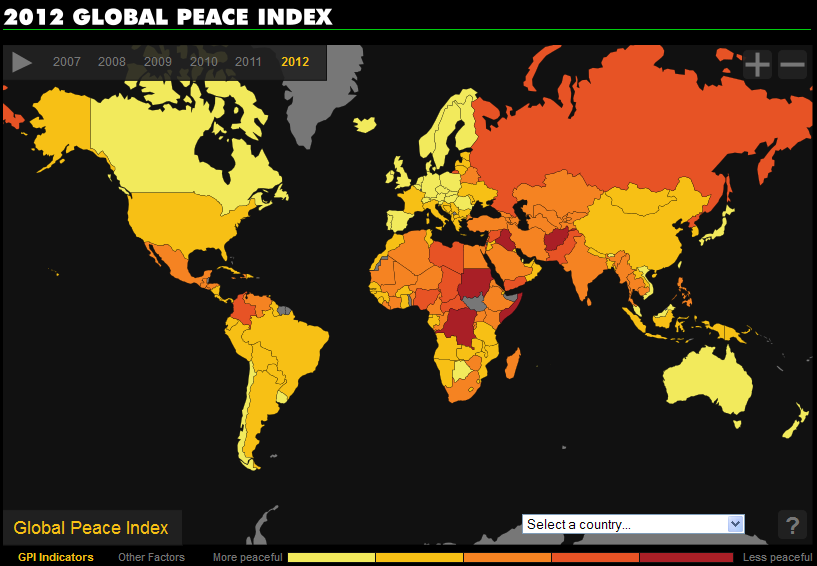
Vision for Humanity has compiled the Global Peace Index (GPI) for 2012. The GPI is a composite index that measures the peacefulness of countries around the world. It considers 23 weighted quantitative and qualitative indicators such as perceived criminality in society, access to weapons, imports of weapons, military expenditure, homicides, political instability, jailed population, weapons exports, violent crime, among others.

The lower the score, the more peaceful the nation. I that context, the most peaceful country is Iceland, followed by Denmark, New Zealand, Canada and Japan. On the other end of the spectrum, the least peaceful country is Somalia, followed by Afghanistan, Sudan, Iraq and the Democratic Republic of Congo.

The interactive map can be found at: Vision of Humanity: 2012 Global Peace Index

For detailed information about the GPI and its methodology, visit: Institute for Economics and Peace: Global Peace Index 2012


Gun-Related Deaths vs. Gun Ownership in the U.S.

click to enlarge

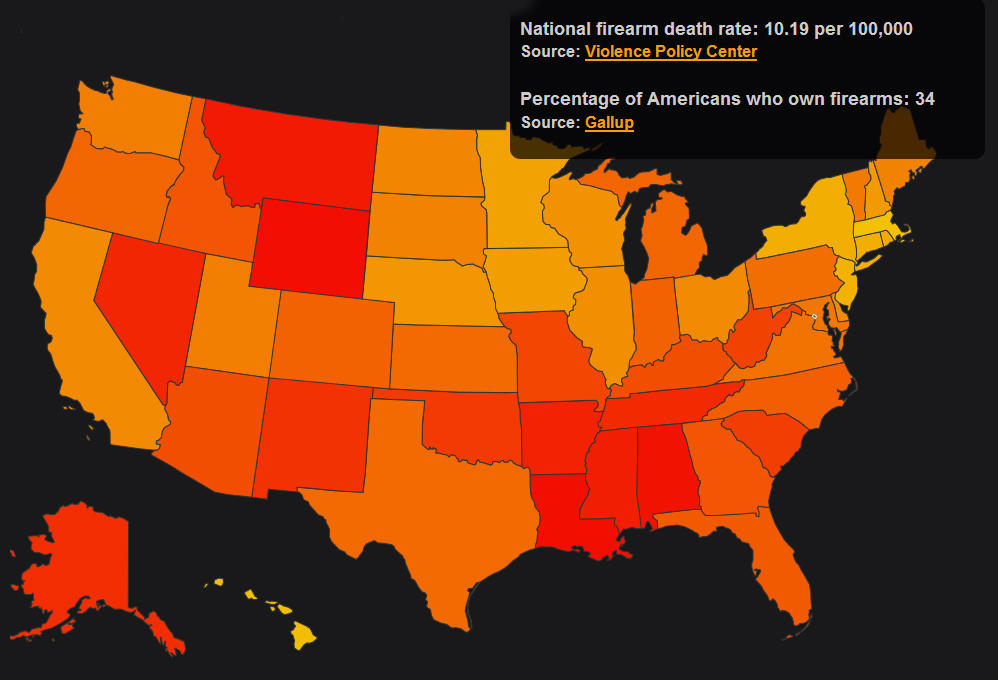
According to data from The Violence and Policy Center, the death rate by firearms in the U.S. is 10.19 per 100,000 people. Data from Gallup puts gun ownership at 34% nationwide. States with higher percentage of gun ownership also show a high number of deaths by firearms. Louisiana ranks 1 in number of deaths by firearms at 18.03 per 100,000, and 13 in gun ownership at 45.6%. Wyoming ranks 2 in number of deaths by firearms at 17.64 per 100,000, and 2 in gun ownership at 62.8%. These states are followed by Montana, Mississippi, Arkansas, Nevada, Tennessee and Alaska. In comparison, Massachusetts ranks 50 in number of deaths by firearms at 3.14 per 100,000 (lowest of all fifty states), and 48 in gun ownership at 12.8%. Hawaii fares well, ranking 49 in number of deaths by firearms, and 50 in gun ownership at 9.7% (the lowest of all fifty states).

See interactive map at: Aljazeera.com – Interactive: US, Yemen lead the world in guns