Category Archives: Rankings

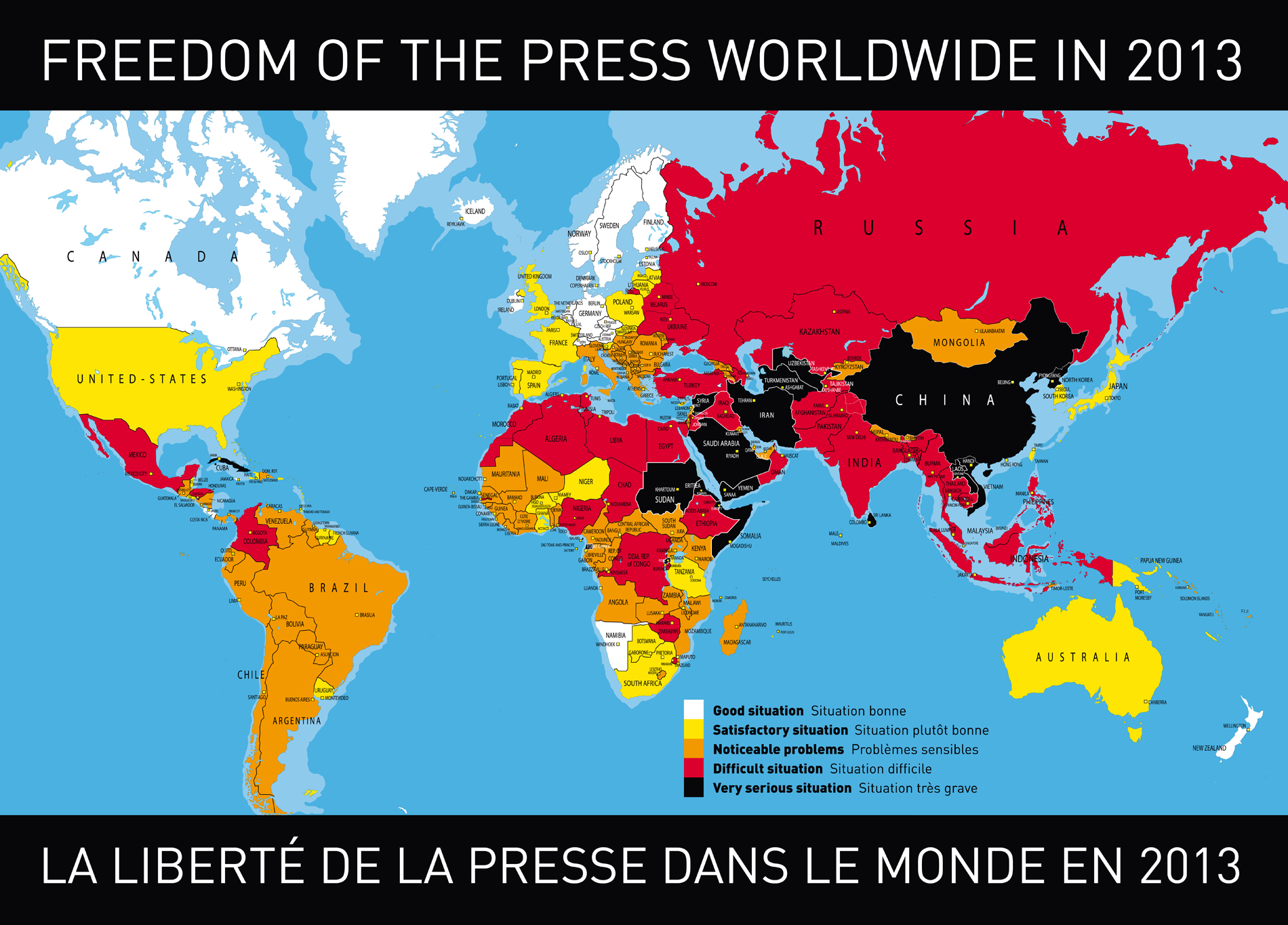
Freedom of the Press Index 2013

Freedom of the Press Index 2013

Reporters Without Borders released this week its freedom of the press report for 2013. According to the report, countries where press freedoms are curtailed the most are Turkmenistan, North Korea, Eritrea. In contrast, the countries where freedom of the press is respected the most are Finland, the Netherlands, and Norway. The map above shows the state of world press freedoms for 2013.

Military Spending Worldwide

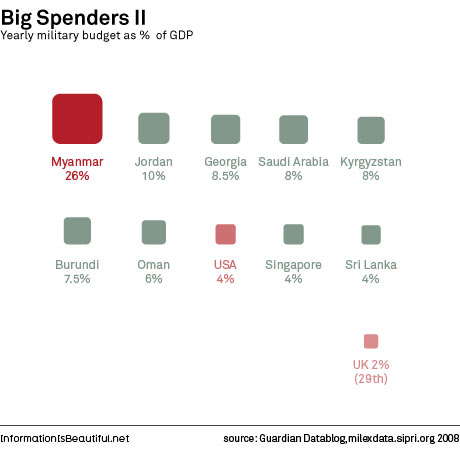
According to an article of The Guardian, in 2008 the defense budget of the United States was $607 billion, ten times that of China and the UK, fifteen times that of Germany, seventeen times that of Russia, and twenty five times that of India. In fact, the defense budget of the top nine countries combined (shown in the first graphic) adds up to $377 billion, or 62% of the military spending of the U.S. Those numbers would make the U.S. the top country in defense spending in the world.

But, if one looks at defense spending numbers as a percentage of the GDP, we have a different story. In that case, Myanmar becomes the top defense spender with a military budget of 26% of its GDP, followed by Jordan, Georgia and Saudi Arabia. The U.S. moves to number eight, with a military budget of 4% of its GDP. Large military spending by these nations is due to different factors. Some of these countries are dictatorships, some are monarchies. Others need to actively protect their borders from foreign aggression.

To read the article from The Guardian, visit: The Guardian: Data Store – Show and Tell, Information is beautiful: war games


The Happy Planet Index 2012

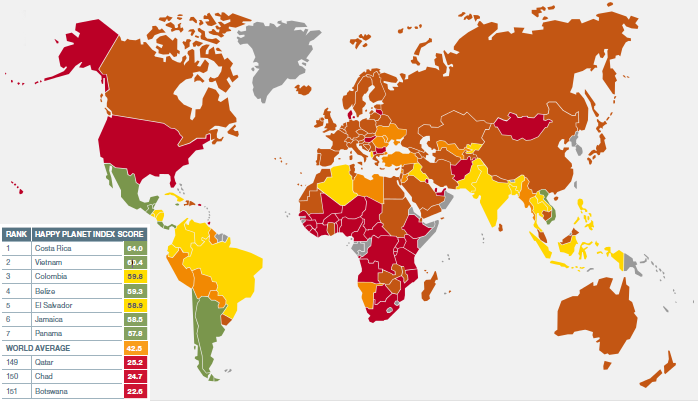
The Happy Planet Index (HPI) measures how countries provide their citizens with a long and happy existence within their borders.

The HPI measures three variables: experienced well-being, life expectancy and environmental footprint. Environmental footprint is a measure of resource consumption. Scores for each variable are combined to create an overall measurement, where the color green represents the best performance for all three variables. The HPI has been calculated for 151 countries.

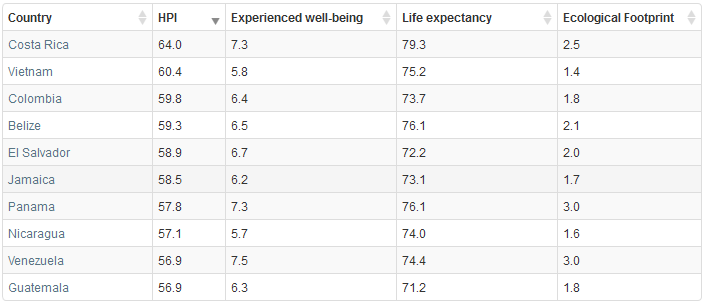
The highest ranking countries on the HPI are: Costa Rica, Vietnam, Belize, Colombia and El Salvador. See table below:

For more information about the HPI methodology, definitions and the complete list of ranked countries, please visit: The Happy Planet Index


Countries With the Largest Gold Reserves

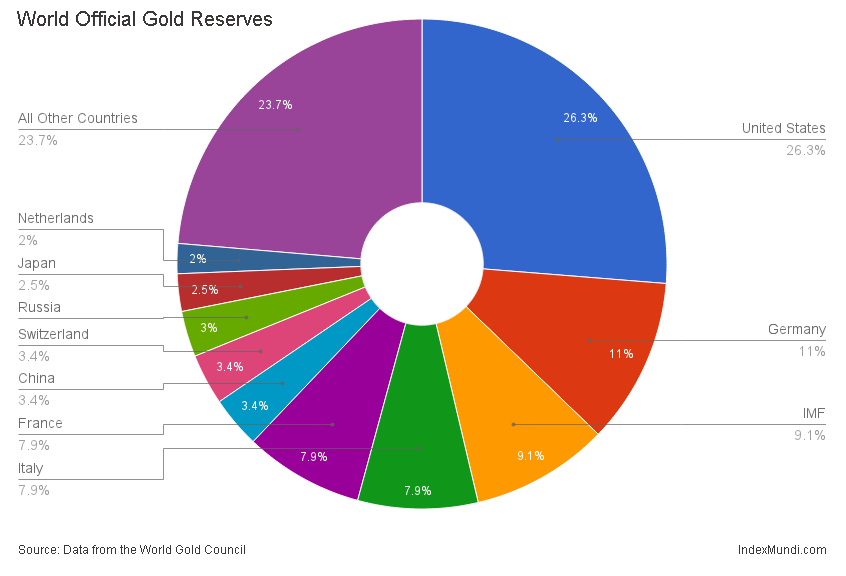
According to a World Gold Council report, world official gold reserves are estimated to be 31,575 tonnes as of January 2013. The United States ranks number one in official gold holdings with 8,133 tonnes. It is followed by Germany, the IMF (International Monetary Fund), Italy, France, China, Switzerland, Russia, Japan and the Netherlands. All other countries combined hold 7,325.5 tonnes in gold reserves. The countries in that group include India, Taiwan, Portugal, Venezuela, Saudi Arabia and Turkey. The Euro area holds 10,783 tonnes in gold reserves.

Resource Investor reports that central banks increased their official gold holdings to 500 tonnes in 2012 from 465 tonnes in 2011.

Resources:


Gun Ownership Worldwide

click to enlarge

Using data from the United Nations Office on Drugs and Crime (UNODC) on homicides by firearms worldwide, we can see that the United States has the highest average of gun ownership, 88.8 per 100 people. The U.S. is followed by Yemen with 54.8 average per 100 people, Switzerland with 45.7, and Finland with 45.3 average per 100 people. Although, these countries rate at the top in gun ownership, their numbers are much lower compared to the U.S.

According to this data, countries with the lowest gun ownership include: Tunisia, East Timor, Ethiopia, Ghana, Bangladesh, Eritrea, Fiji, among others.

For more information visit:


The Cheapest and Most Expensive Places to Fill Your Gas Tank

click to enlarge

Gas prices go up or down according to supply-demand forces and to movements in the commodities market. According to this map, published by the Car and Driver blog, prices in the United States ($3.85 per gallon) are not that bad compared to gas prices in other countries.

European nations have the highest gas prices, above $7 per gallon. If you were in Turkey you will have to pay the highest price, a steep $9.39 per gallon. Turkey’s gas prices are followed by Norway ($9.38), Italy ( $9.00), Sweden ($8.75), the United Kingdom ($8.46), Germany ($8.29), and Iceland ($8.01).

In the Americas, the highest gas prices can be found in Belize ($7.59), followed by Uruguay ($6.99), Chile($6.60), Peru ($5.95), Argentina ($5.52) and Canada ($5.14). Gas prices are significantly low in Venezuela ($0.06) and Bolivia ($2.05) due to government subsidies.

Africa enjoys low gas prices, except for Djibouti ($6.48), Madagascar ($5.74), Zimbabwe ($5.38), and South Africa ($5.15).

In Asia, Japan pays the highest gas prices, $6.87 per gallon, followed by the Philippines ($5.43), and India ($5.42).

In Australia, New Zealand and Australia’s gas prices per gallon are $6.75 and $5.64, respectively.
 

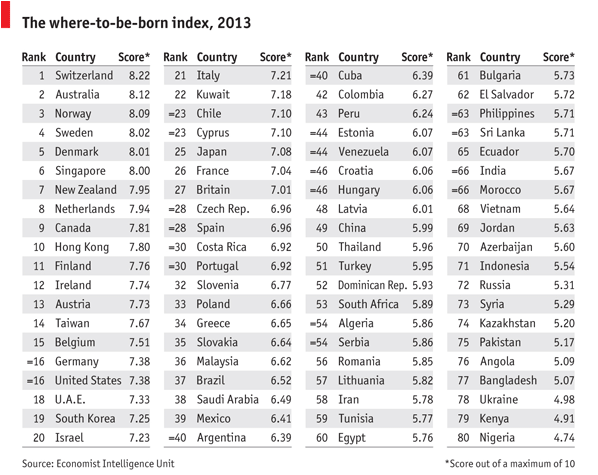
The Best and Worst Places to be Born in 2013

Back in 1988, the United States was ranked first as the best country to be born. Twenty five years later, the U.S. is ranked number 16.

The Economist Intelligence Unit compiled the where-to-be-born index which measures which country will provide the best opportunities to someone born in 2013. It links the results of life satisfaction surveys to indicators that affect the quality of life in those countries, such as geography, demographics, culture, government policies, the economy, etc.

Based on those factors, the best places to be born are Switzerland, Australia followed by Norway, Sweden Denmark, and Singapore. At the bottom of the list you will find Nigeria, Kenya, Ukraine, Bangladesh, Angola, Pakistan, among others.


Pope Benedict XVI is on Twitter

click to enlarge

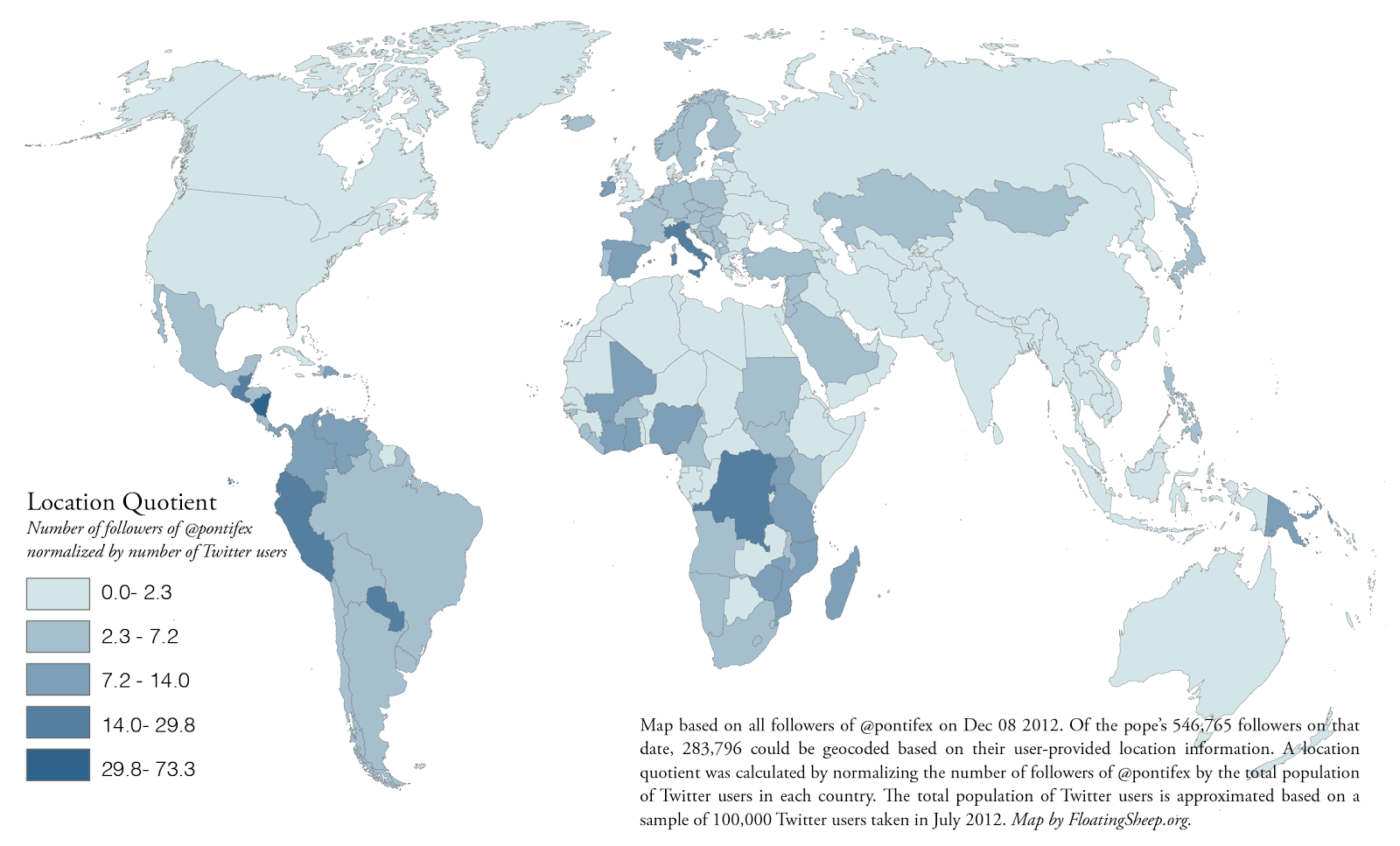
Pope Benedict XVI has Twitter presence beginning December, 2012. His English language account @Pontifex already has 1,342,380 followers from all around the world, and has sent 14 tweets. The Floating Sheep blog mapped followers of this account based on their location as of December 8, 2012. According to this map, the largest number of followers were located in Italy and Nicaragua, followed by the Democratic Republic of Congo, Guatemala, Peru, Ecuador, Paraguay, Spain and Ireland among others.


The Global Public Debt Clock is Ticking

click to enlarge

Global public debt is increasing every second. This debt clock shows government debt, in dollar terms, for almost all countries. Governments with the highest debt include the United States, Canada, Brazil, Australia, India, China, and several western European nations.

Additional indicators such as public debt per person, public debt as percentage of GDP, total annual debt change, and country debt comparisons can be seen in the interactive map at: The Economist: The global debt clock


Vulnerability to Climate Change

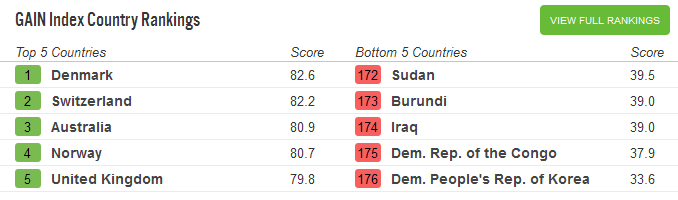
The Global Adaptation Institute (GAIN) created the GAIN Index to measure the vulnerability of countries to climate change, combined with how well prepared these countries are to face the global challenges associated with it.

Countries at extreme risk include North Korea, the Democratic Republic of Congo, Iraq, Burundi, Chad, Sudan and Zimbabwe. At the other end of the spectrum, countries with the lowest risk include Denmark, Australia, Switzerland, Norway, the UK, New Zealand, Norway, to name a few.

For a complete list of countries and index methodology visit: The Global Adaptation Institute: The GAIN Index