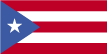
| Country name | conventional long form: Commonwealth of Puerto Rico conventional short form: Puerto Rico abbreviation: PR etymology: Christopher COLUMBUS named the island San Juan Bautista (Saint John the Baptist) and the capital city and main port Cuidad de Puerto Rico (Rich Port City); over time, however, the names were shortened and transposed and the island came to be called Puerto Rico and its capital San Juan |
| Dependency status | unincorporated organized territory of the US; policy relations between Puerto Rico and the US conducted under the jurisdiction of the Office of the President |
| Government type | republican form of government with separate executive, legislative, and judicial branches; unincorporated organized territory of the US with local self-government Note: reference Puerto Rican Federal Relations Act, 2 March 1917, as amended by Public Law 600, 3 July 1950 |
| Capital | name: San Juan geographic coordinates: 18 28 N, 66 07 W time difference: UTC-4 (1 hour ahead of Washington, DC, during Standard Time) etymology: the name dates to 1521 and the founding of the city under the name "Ciudad de San Juan Bautista de Puerto Rico" (City of Saint John the Baptist of Puerto Rico) |
| Administrative divisions | none (territory of the US); there are no first-order administrative divisions as defined by the US Government, but there are 78 municipalities (municipios, singular - municipio) at the second order; Adjuntas, Aguada, Aguadilla, Aguas Buenas, Aibonito, Anasco, Arecibo, Arroyo, Barceloneta, Barranquitas, Bayamon, Cabo Rojo, Caguas, Camuy, Canovanas, Carolina, Catano, Cayey, Ceiba, Ciales, Cidra, Coamo, Comerio, Corozal, Culebra, Dorado, Fajardo, Florida, Guanica, Guayama, Guayanilla, Guaynabo, Gurabo, Hatillo, Hormigueros, Humacao, Isabela, Jayuya, Juana Diaz, Juncos, Lajas, Lares, Las Marias, Las Piedras, Loiza, Luquillo, Manati, Maricao, Maunabo, Mayaguez, Moca, Morovis, Naguabo, Naranjito, Orocovis, Patillas, Penuelas, Ponce, Quebradillas, Rincon, Rio Grande, Sabana Grande, Salinas, San German, San Juan, San Lorenzo, San Sebastian, Santa Isabel, Toa Alta, Toa Baja, Trujillo Alto, Utuado, Vega Alta, Vega Baja, Vieques, Villalba, Yabucoa, Yauco |
| Independence | none (territory of the US with commonwealth status) |
| National holiday | US Independence Day, 4 July (1776); Puerto Rico Constitution Day, 25 July (1952) |
| Constitution | history: previous 1900 (Organic Act, or Foraker Act); latest ratified by referendum 3 March 1952, approved 3 July 1952, effective 25 July 1952 amendments: proposed by a concurrent resolution of at least two-thirds majority by the total Legislative Assembly membership; approval requires at least two-thirds majority vote by the membership of both houses and approval by a majority of voters in a special referendum; if passed by at least three-fourths Assembly vote, the referendum can be held concurrently with the next general election; constitutional articles such as the republican form of government or the bill of rights cannot be amended; amended 1952 |
| Legal system | civil law system based on the Spanish civil code and within the framework of the US federal system |
| Citizenship | see United States |
| Suffrage | 18 years of age; universal; note - island residents are US citizens but do not vote in US presidential elections |
| Executive branch | chief of state: President Joseph R. BIDEN Jr. (since 20 January 2021); Vice President Kamala D. HARRIS (since 20 January 2021) head of government: Governor Pedro PIERLUISI (since 2 January 2021) cabinet: Cabinet appointed by governor with the consent of the Legislative Assembly elections/appointments: president and vice president indirectly elected on the same ballot by an Electoral College of 'electors' chosen from each state; president and vice president serve a 4-year term (eligible for a second term); under the US Constitution, residents of Puerto Rico do not vote in elections for US president and vice president; however, they may vote in Democratic and Republican party presidential primary elections; governor directly elected by simple majority popular vote for a 4-year term (no term limits); election last held on 3 November 2020 (next to be held on November 2024) election results: Pedro PIERLUISI elected governor; percent of vote - Pedro PIERLUISI (PNP) 32.9%, Carlos DELGADO (PPD) 31.6%, Alexandra LUGARO (independent) 14.2%, Juan DALMAU (PIP) 13.7% note: on 24 July 2019, Governor Ricardo ROSSELLO announced his resignation effective 2 August 2019; as Secretary of State, Pedro PIERLUISI succeeded Governor Ricardo ROSSELLO; on 7 August 2019 the Supreme Court of Puerto Rico ruled Pedro PIERLUISI accession was unconstitutional and Wanda VAZQUEZ is sworn in as governor |
| Legislative branch | description: bicameral Legislative Assembly or Asamblea Legislativa consists of: Senate or Senado (30 seats; 16 members directly elected in 8 2-seat constituencies by simple majority vote and 14 at-large members directly elected by simple majority vote to serve 4-year terms) House of Representatives or Camara de Representantes (51 seats; members directly elected in single-seat constituencies by simple majority vote to serve 4-year terms) elections: Senate - last held on 8 November 2016 (next to be held on 3 November 2020) House of Representatives - last held on 8 November 2016 (next to be held on 3 November 2020) election results: Senate - percent of vote by party - NA; seats by party - PNP 21, PPD 7, PIP 1, Independent 1; composition - men 23, women 7, percent of women 23.3% House of Representatives - percent of vote by party - NA; seats by party - PNP 34, PPD 16, PIP 1; composition - men 11, women 4, percent of women 26.7%; total Legislative Assembly percent of women 16% note: Puerto Rico directly elects 1 member by simple majority vote to serve a 4-year term as a commissioner to the US House of Representatives; the commissioner can vote when serving on a committee and when the House meets as the Committee of the Whole House but not when legislation is submitted for a 'full floor' House vote; election of commissioner last held on 6 November 2018 (next to be held in November 2022) |
| Judicial branch | highest courts: Supreme Court (consists of the chief justice and 8 associate justices) judge selection and term of office: justices appointed by the governor and confirmed by majority Senate vote; judges serve until compulsory retirement at age 70 subordinate courts: Court of Appeals; First Instance Court comprised of superior and municipal courts |
| Political parties and leaders | National Democratic Party [Charlie RODRIGUEZ] National Republican Party of Puerto Rico [Jenniffer GONZALEZ] New Progressive Party or PNP [Ricardo ROSSELLO] (pro-US statehood) Popular Democratic Party or PPD [Alejandro GARCIA Padillo] (pro-commonwealth) Puerto Rican Independence Party or PIP [Ruben BERRIOS Martinez] (pro-independence) |
| International organization participation | AOSIS (observer), Caricom (observer), Interpol (subbureau), IOC, UNWTO (associate), UPU, WFTU (NGOs) |
| Diplomatic representation in the US | none (territory of the US) |
| Diplomatic representation from the US | embassy: none (territory of the US with commonwealth status) |
| Flag description | five equal horizontal bands of red (top, center, and bottom) alternating with white; a blue isosceles triangle based on the hoist side bears a large, white, five-pointed star in the center; the white star symbolizes Puerto Rico; the three sides of the triangle signify the executive, legislative and judicial parts of the government; blue stands for the sky and the coastal waters; red symbolizes the blood shed by warriors, while white represents liberty, victory, and peace note: design initially influenced by the US flag, but similar to the Cuban flag, with the colors of the bands and triangle reversed |
| National symbol(s) | Puerto Rican spindalis (bird), coqui (frog); national colors: red, white, blue |
| National anthem | name: "La Borinquena" (The Puerto Rican) lyrics/music: Manuel Fernandez JUNCOS/Felix Astol ARTES note: music adopted 1952, lyrics adopted 1977; the local anthem's name is a reference to the indigenous name of the island, Borinquen; the music was originally composed as a dance in 1867 and gained popularity in the early 20th century; there is some evidence that the music was written by Francisco RAMIREZ; as a commonwealth of the US, "The Star-Spangled Banner" is official (see United States) |
Source: CIA World Factbook
This page was last updated on September 18, 2021