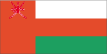
| Location | Middle East, bordering the Arabian Sea, Gulf of Oman, and Persian Gulf, between Yemen and the UAE |
| Geographic coordinates | 21 00 N, 57 00 E |
| Map references | Middle East |
| Area | total: 309,500 sq km land: 309,500 sq km water: 0 sq km |
| Area - comparative | twice the size of Georgia |
| Land boundaries | total: 1,561 km border countries (3): Saudi Arabia 658 km, UAE 609 km, Yemen 294 km |
| Coastline | 2,092 km |
| Maritime claims | territorial sea: 12 nm contiguous zone: 24 nm exclusive economic zone: 200 nm |
| Climate | dry desert; hot, humid along coast; hot, dry interior; strong southwest summer monsoon (May to September) in far south |
| Terrain | central desert plain, rugged mountains in north and south |
| Elevation extremes | highest point: Jabal Shams 3,004 m lowest point: Arabian Sea 0 m mean elevation: 310 m |
| Natural resources | petroleum, copper, asbestos, some marble, limestone, chromium, gypsum, natural gas |
| Land use | agricultural land: 4.7% (2018 est.) arable land: 0.1% (2018 est.) permanent crops: 0.1% (2018 est.) permanent pasture: 4.5% (2018 est.) forest: 0% (2018 est.) other: 95.3% (2018 est.) |
| Irrigated land | 590 sq km (2012) |
| Total renewable water resources | 1.4 billion cubic meters (2017 est.) |
| Natural hazards | summer winds often raise large sandstorms and dust storms in interior; periodic droughts |
| Geography - note | consists of Oman proper and two northern exclaves, Musandam and Al Madhah; the former is a peninsula that occupies a strategic location adjacent to the Strait of Hormuz, a vital transit point for world crude oil |
Source: CIA World Factbook
This page was last updated on September 18, 2021