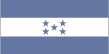
| Country name | conventional long form: Republic of Honduras conventional short form: Honduras local long form: Republica de Honduras local short form: Honduras etymology: the name means "depths" in Spanish and refers to the deep anchorage in the northern Bay of Trujillo |
| Government type | presidential republic |
| Capital | name: Tegucigalpa; note - article eight of the Honduran constitution states that the twin cities of Tegucigalpa and Comayaguela, jointly, constitute the capital of the Republic of Honduras; however, virtually all governmental institutions are on the Tegucigalpa side, which in practical terms makes Tegucigalpa the capital geographic coordinates: 14 06 N, 87 13 W time difference: UTC-6 (1 hour behind Washington, DC during Standard Time) etymology: while most sources agree that Tegucigalpa is of Nahuatl derivation, there is no consensus on its original meaning |
| Administrative divisions | 18 departments (departamentos, singular - departamento); Atlantida, Choluteca, Colon, Comayagua, Copan, Cortes, El Paraiso, Francisco Morazan, Gracias a Dios, Intibuca, Islas de la Bahia, La Paz, Lempira, Ocotepeque, Olancho, Santa Barbara, Valle, Yoro |
| Independence | 15 September 1821 (from Spain) |
| National holiday | Independence Day, 15 September (1821) |
| Constitution | history: several previous; latest approved 11 January 1982, effective 20 January 1982 amendments: proposed by the National Congress with at least two-thirds majority vote of the membership; passage requires at least two-thirds majority vote of Congress in its next annual session; constitutional articles, such as the form of government, national sovereignty, the presidential term, and the procedure for amending the constitution, cannot be amended; amended several times, last in 2021 |
| Legal system | civil law system |
| International law organization participation | accepts compulsory ICJ jurisdiction with reservations; accepts ICCt jurisdiction |
| Citizenship | citizenship by birth: yes citizenship by descent only: yes dual citizenship recognized: yes residency requirement for naturalization: 1 to 3 years |
| Suffrage | 18 years of age; universal and compulsory |
| Executive branch | chief of state: President Juan Orlando HERNANDEZ Alvarado (since 27 January 2014); Vice Presidents Ricardo ALVAREZ, Maria RIVERA, and Olga ALVARADO (since 26 January 2018); note - the president is both chief of state and head of government head of government: President Juan Orlando HERNANDEZ Alvarado (since 27 January 2014); Vice Presidents Ricardo ALVAREZ, Maria RIVERA, and Olga ALVARADO (since 26 January 2018) cabinet: Cabinet appointed by president elections/appointments: president directly elected by simple majority popular vote for a 4-year term; election last held on 26 November 2017 (next to be held in November 2021); note - in 2015, the Constitutional Chamber of the Honduran Supreme Court struck down the constitutional provisions on presidential term limits election results: 2017: Juan Orlando HERNANDEZ Alvarado reelected president; percent of vote - Juan Orlando HERNANDEZ Alvarado (PNH) 43%, Salvador NASRALLA (Alianza de Oposicion conta la Dictadura) 41.4%, Luis Orlando ZELAYA Medrano (PL) 14.7%, other .9% 2013: Juan Orlando HERNANDEZ Alvarado elected president; percent of vote - Juan Orlando HERNANDEZ Alvarado (PNH) 36.9%, Xiomara CASTRO (LIBRE) 28.8%, Mauricio VILLEDA (PL) 20.3%, Salvador NASRALLA (PAC) 13.4%, other 0.6% |
| Legislative branch | description: unicameral National Congress or Congreso Nacional (128 seats; members directly elected in 18 multi-seat constituencies by closed party-list proportional representation vote; members serve 4-year terms) elections: last held on 27 November 2017 (next to be held on 27 November 2021) election results: percent of vote by party - PNH 47.7%, LIBRE 23.4%, PL 20.3%, AP 3.1%, PINU 3.1%, DC 0.8%, PAC 0.8%, UD 0.8%; seats by party - PNH 61, LIBRE 30, PL 26, AP 4, PINU 4, DC 1, PAC 1, UD 1; composition - men 101, women 27, percent of women 21.1% |
| Judicial branch | highest courts: Supreme Court of Justice or Corte Suprema de Justicia (15 principal judges, including the court president, and 7 alternates; court organized into civil, criminal, constitutional, and labor chambers); note - the court has both judicial and constitutional jurisdiction judge selection and term of office: court president elected by his peers; judges elected by the National Congress from candidates proposed by the Nominating Board, a diverse 7-member group of judicial officials and other government and non-government officials nominated by each of their organizations; judges elected by Congress for renewable, 7-year terms subordinate courts: courts of appeal; courts of first instance; justices of the peace |
| Political parties and leaders | Alliance against the Dictatorship or Alianza de Oposicion conta la Dictadura [Salvador NASRALLA] (electoral coalition) Anti-Corruption Party or PAC [Marlene ALVARENGA] Christian Democratic Party or DC [Lucas AGUILERA] Democratic Unification Party or UD [Alfonso DIAZ] Freedom and Refoundation Party or LIBRE [Jose Manuel ZELAYA Rosales] Honduran Patriotic Alliance or AP [Romeo VASQUEZ Velasquez] Liberal Party or PL [Luis Orlando ZELAYA Medrano] National Party of Honduras or PNH [Reinaldo SANCHEZ Rivera] Innovation and Unity Party or PINU [Guillermo VALLE] |
| International organization participation | BCIE, CACM, CD, CELAC, EITI (candidate country), FAO, G-11, G-77, IADB, IAEA, IBRD, ICAO, ICCt, ICRM, IDA, IFAD, IFC, IFRCS, ILO, IMF, IMO, Interpol, IOC (suspended), IOM, IPU, ISO (subscriber), ITSO, ITU, ITUC (NGOs), LAES, LAIA (observer), MIGA, MINURSO, MINUSTAH, NAM, OAS, OPANAL, OPCW, Pacific Alliance (observer), PCA, Petrocaribe, SICA, UN, UNCTAD, UNESCO, UNIDO, Union Latina, UNWTO, UPU, WCO (suspended), WFTU (NGOs), WHO, WIPO, WMO, WTO |
| Diplomatic representation in the US | chief of mission: Ambassador Luis Fernando SUAZO BARAHONA (since 17 September 2020) chancery: 1220 19th Street NW, Suite #320, Washington, DC 20036 telephone: [1] (202) 966-7702 FAX: [1] (202) 966-9751 email address and website: https://hondurasembusa.org/ consulate(s) general: Atlanta, Chicago, Houston, Los Angeles, Miami, New Orleans, New York, San Francisco consulate(s): Dallas, McAllen (TX) |
| Diplomatic representation from the US | chief of mission: Ambassador (vacant); Charge d'Affaires Colleen A. HOEY (since August 2019) embassy: Avenida La Paz, Tegucigalpa M.D.C. mailing address: 3480 Tegucigalpa Place, Washington DC 20521-3480 telephone: [504] 2236-9320, FAX: [504] 2236-9037 email address and website: usahonduras@state.gov https://hn.usembassy.gov/ |
| Flag description | three equal horizontal bands of cerulean blue (top), white, and cerulean blue, with five cerulean, five-pointed stars arranged in an X pattern centered in the white band; the stars represent the members of the former Federal Republic of Central America: Costa Rica, El Salvador, Guatemala, Honduras, and Nicaragua; the blue bands symbolize the Pacific Ocean and the Caribbean Sea; the white band represents the land between the two bodies of water and the peace and prosperity of its people note: similar to the flag of El Salvador, which features a round emblem encircled by the words REPUBLICA DE EL SALVADOR EN LA AMERICA CENTRAL centered in the white band; also similar to the flag of Nicaragua, which features a triangle encircled by the words REPUBLICA DE NICARAGUA on top and AMERICA CENTRAL on the bottom, centered in the white band |
| National symbol(s) | scarlet macaw, white-tailed deer; national colors: blue, white |
| National anthem | name: "Himno Nacional de Honduras" (National Anthem of Honduras) lyrics/music: Augusto Constancio COELLO/Carlos HARTLING note: adopted 1915; the anthem's seven verses chronicle Honduran history; on official occasions, only the chorus and last verse are sung |
Source: CIA World Factbook
This page was last updated on September 18, 2021