| Country name | conventional long form: Commonwealth of Australia conventional short form: Australia etymology: the name Australia derives from the Latin "australis" meaning "southern"; the Australian landmass was long referred to as "Terra Australis" or the Southern Land |
| Government type | federal parliamentary democracy under a constitutional monarchy; a Commonwealth realm |
| Capital | name: Canberra geographic coordinates: 35 16 S, 149 08 E time difference: UTC+10 (15 hours ahead of Washington, DC, during Standard Time) daylight saving time: +1hr, begins first Sunday in October; ends first Sunday in April note: Australia has four time zones, including Lord Howe Island (UTC+10:30) etymolgy: the name is claimed to derive from either Kambera or Camberry, which are names corrupted from the original native designation for the area "Nganbra" or "Nganbira" |
| Administrative divisions | 6 states and 2 territories*; Australian Capital Territory*, New South Wales, Northern Territory*, Queensland, South Australia, Tasmania, Victoria, Western Australia |
| Dependent areas | Ashmore and Cartier Islands, Christmas Island, Cocos (Keeling) Islands, Coral Sea Islands, Heard Island and McDonald Islands, Norfolk Island |
| Independence | 1 January 1901 (from the federation of UK colonies) |
| National holiday | Australia Day (commemorates the arrival of the First Fleet of Australian settlers), 26 January (1788); ANZAC Day (commemorates the anniversary of the landing of troops of the Australian and New Zealand Army Corps during World War I at Gallipoli, Turkey), 25 April (1915) |
| Constitution | history: approved in a series of referenda from 1898 through 1900 and became law 9 July 1900, effective 1 January 1901 amendments: proposed by Parliament; passage requires approval of a referendum bill by absolute majority vote in both houses of Parliament, approval in a referendum by a majority of voters in at least four states and in the territories, and Royal Assent; proposals that would reduce a state’s representation in either house or change a state’s boundaries require that state’s approval prior to Royal Assent; amended several times, last in 1977 |
| Legal system | common law system based on the English model |
| International law organization participation | accepts compulsory ICJ jurisdiction with reservations; accepts ICCt jurisdiction |
| Citizenship | citizenship by birth: no citizenship by descent only: at least one parent must be a citizen or permanent resident of Australia dual citizenship recognized: yes residency requirement for naturalization: 4 years |
| Suffrage | 18 years of age; universal and compulsory |
| Executive branch | chief of state: Queen ELIZABETH II (since 6 February 1952); represented by Governor General David HURLEY (since 1 July 2019) head of government: Prime Minister Scott MORRISON (since 24 August 2018) cabinet: Cabinet nominated by the prime minister from among members of Parliament and sworn in by the governor general elections/appointments: the monarchy is hereditary; governor general appointed by the monarch on the recommendation of the prime minister; following legislative elections, the leader of the majority party or majority coalition is sworn in as prime minister by the governor general |
| Legislative branch | description: bicameral Federal Parliament consists of: Senate (76 seats; 12 members from each of the 6 states and 2 each from the 2 mainland territories; members directly elected in multi-seat constituencies by proportional representation vote; members serve 6-year terms with one-half of state membership renewed every 3 years and territory membership renewed every 3 years) House of Representatives (151 seats; members directly elected in single-seat constituencies by majority preferential vote; members serve terms of up to 3 years) elections: Senate - last held on 18 May 2019 (next to be held in 2022) House of Representatives - last held on 18 May 2019 (next to be held in 2022) election results: Senate - percent of vote by party - Liberal/National coalition 37.99%, ALP 28.79%, The Greens 10.19%, One Nation 5.4%, Centre Alliance .19%, Lambie Network .21%, other 17.23%; seats by party - Liberal/National coalition 35, ALP 26, The Greens 9, One Nation 2, Centre Alliance 2, Lambie Network 1, independents 1 House of Representatives - percent of vote by party - Liberal/National coalition 41.4%, ALP 33.3%, The Greens 10.4%, Katter's Australian Party .49%, Centre Alliance .33%, independents 3.37%, other 10.63%; seats by party - Liberal/National Coalition 77, ALP 68, The Greens 1, Katter's Australian Party 1, Centre Alliance 1, independent 3 |
| Judicial branch | highest courts: High Court of Australia (consists of 7 justices, including the chief justice); note - each of the 6 states, 2 territories, and Norfolk Island has a Supreme Court; the High Court is the final appellate court beyond the state and territory supreme courts judge selection and term of office: justices appointed by the governor-general in council for life with mandatory retirement at age 70 subordinate courts: at the federal level: Federal Court; Federal Magistrates' Courts of Australia; Family Court; at the state and territory level: Local Court - New South Wales; Magistrates' Courts – Victoria, Queensland, South Australia, Western Australia, Tasmania, Northern Territory, Australian Capital Territory; District Courts – New South Wales, Queensland, South Australia, Western Australia; County Court – Victoria; Family Court – Western Australia; Court of Petty Sessions – Norfolk Island |
| Political parties and leaders | Australian Greens Party [Adam BANDT] Australian Labor Party or ALP [Anthony ALBANESE] Country Liberal Party or CLP [Gary HIGGINS] Liberal National Party of Queensland or LNP [Deborah FRECKLINGTON] Liberal Party of Australia [Scott MORRISON] The Nationals [Michael MCCORMACK] Centre Alliance [Nick XENOPHON] Pauline Hanson’s One Nation [Pauline HANSON] |
| International organization participation | ADB, ANZUS, APEC, ARF, ASEAN (dialogue partner), Australia Group, BIS, C, CD, CP, EAS, EBRD, EITI (implementing country), FAO, FATF, G-20, IAEA, IBRD, ICAO, ICC (national committees), ICCt, ICRM, IDA, IEA, IFC, IFRCS, IHO, ILO, IMF, IMO, IMSO, Interpol, IOC, IOM, IPU, ISO, ITSO, ITU, ITUC (NGOs), MIGA, NEA, NSG, OECD, OPCW, OSCE (partner), Pacific Alliance (observer), Paris Club, PCA, PIF, SAARC (observer), SICA (observer), Sparteca, SPC, UN, UNCTAD, UNESCO, UNHCR, UNMISS, UNMIT, UNRWA, UNTSO, UNWTO, UPU, WCO, WFTU (NGOs), WHO, WIPO, WMO, WTO, ZC |
| Diplomatic representation in the US | chief of mission: Ambassador Arthur SINODINOS (since 6 February 2020) chancery: 1601 Massachusetts Avenue NW, Washington, DC 20036 telephone: [1] (202) 797-3000 FAX: [1] (202) 797-3168 email address and website: https://usa.embassy.gov.au/ consulate(s) general: Chicago, Honolulu, Houston, Los Angeles, New York, San Francisco |
| Diplomatic representation from the US | chief of mission: Ambassador (vacant); Charge d'Affaires Michael GOLDMAN (since 19 January 2021) embassy: Moonah Place, Yarralumla, Australian Capital Territory 2600 mailing address: 7800 Canberra Place, Washington DC 20512-7800 telephone: [61] (02) 6214-5600 FAX: [61] (02) 9373-9184 email address and website: AskEmbassyCanberra@state.gov https://au.usembassy.gov/ consulate(s) general: Melbourne, Perth, Sydney |
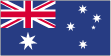
| Flag description | blue with the flag of the UK in the upper hoist-side quadrant and a large seven-pointed star in the lower hoist-side quadrant known as the Commonwealth or Federation Star, representing the federation of the colonies of Australia in 1901; the star depicts one point for each of the six original states and one representing all of Australia's internal and external territories; on the fly half is a representation of the Southern Cross constellation in white with one small, five-pointed star and four larger, seven-pointed stars |
| National symbol(s) | Commonwealth Star (seven-pointed Star of Federation), golden wattle tree (Acacia pycnantha Benth), kangaroo, emu; national colors: green, gold |
| National anthem | name: Advance Australia Fair lyrics/music: Peter Dodds McCORMICK note: adopted 1984; although originally written in the late 19th century, the anthem was not used for all official occasions until 1984; as a Commonwealth country, in addition to the national anthem, "God Save the Queen" serves as the royal anthem (see United Kingdom) |
Source: CIA World Factbook
This page was last updated on September 18, 2021