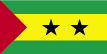
| Location | Central Africa, islands in the Gulf of Guinea, just north of the Equator, west of Gabon |
| Geographic coordinates | 1 00 N, 7 00 E |
| Map references | Africa |
| Area | total: 964 sq km land: 964 sq km water: 0 sq km |
| Area - comparative | more than five times the size of Washington, DC |
| Land boundaries | total: 0 km |
| Coastline | 209 km |
| Maritime claims | territorial sea: 12 nm exclusive economic zone: 200 nm measured from claimed archipelagic baselines |
| Climate | tropical; hot, humid; one rainy season (October to May) |
| Terrain | volcanic, mountainous |
| Elevation extremes | highest point: Pico de Sao Tome 2,024 m lowest point: Atlantic Ocean 0 m |
| Natural resources | fish, hydropower |
| Land use | agricultural land: 50.7% (2018 est.) arable land: 9.1% (2018 est.) permanent crops: 40.6% (2018 est.) permanent pasture: 1% (2018 est.) forest: 28.1% (2018 est.) other: 21.2% (2018 est.) |
| Irrigated land | 100 sq km (2012) |
| Total renewable water resources | 2.18 billion cubic meters (2017 est.) |
| Natural hazards | flooding |
| Geography - note | the second-smallest African country (after the Seychelles); the two main islands form part of a chain of extinct volcanoes and both are mountainous |
Source: CIA World Factbook
This page was last updated on September 18, 2021