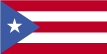
| Location | Caribbean, island between the Caribbean Sea and the North Atlantic Ocean, east of the Dominican Republic |
| Geographic coordinates | 18 15 N, 66 30 W |
| Map references | Central America and the Caribbean |
| Area | total: 9,104 sq km land: 8,959 sq km water: 145 sq km |
| Area - comparative | slightly less than three times the size of Rhode Island |
| Land boundaries | total: 0 km |
| Coastline | 501 km |
| Maritime claims | territorial sea: 12 nm exclusive economic zone: 200 nm |
| Climate | tropical marine, mild; little seasonal temperature variation |
| Terrain | mostly mountains with coastal plain in north; precipitous mountains to the sea on west coast; sandy beaches along most coastal areas |
| Elevation extremes | highest point: Cerro de Punta 1,338 m lowest point: Caribbean Sea 0 m mean elevation: 261 m |
| Natural resources | some copper and nickel; potential for onshore and offshore oil |
| Land use | agricultural land: 22% (2018 est.) arable land: 6.6% (2018 est.) permanent crops: 5.6% (2018 est.) permanent pasture: 9.8% (2018 est.) forest: 63.2% (2018 est.) other: 14.8% (2018 est.) |
| Irrigated land | 220 sq km (2012) |
| Total renewable water resources | 7.1 billion cubic meters (2017 est.) |
| Natural hazards | periodic droughts; hurricanes |
| Geography - note | important location along the Mona Passage - a key shipping lane to the Panama Canal; San Juan is one of the biggest and best natural harbors in the Caribbean; many small rivers and high central mountains ensure land is well watered; south coast relatively dry; fertile coastal plain belt in north |
Source: CIA World Factbook
This page was last updated on September 18, 2021