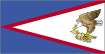
| Location | Oceania, group of islands in the South Pacific Ocean, about halfway between Hawaii and New Zealand |
| Geographic coordinates | 14 20 S, 170 00 W |
| Map references | Oceania |
| Area | total: 224 sq km land: 224 sq km water: 0 sq km note: includes Rose Island and Swains Island |
| Area - comparative | slightly larger than Washington, DC |
| Land boundaries | total: 0 km |
| Coastline | 116 km |
| Maritime claims | territorial sea: 12 nm exclusive economic zone: 200 nm |
| Climate | tropical marine, moderated by southeast trade winds; annual rainfall averages about 3 m; rainy season (November to April), dry season (May to October); little seasonal temperature variation |
| Terrain | five volcanic islands with rugged peaks and limited coastal plains, two coral atolls (Rose Island, Swains Island) |
| Elevation extremes | highest point: Lata Mountain 964 m lowest point: Pacific Ocean 0 m |
| Natural resources | pumice, pumicite |
| Land use | agricultural land: 24.5% (2018 est.) arable land: 15% (2018 est.) permanent crops: 9.5% (2018 est.) permanent pasture: 0% (2018 est.) forest: 75.5% (2018 est.) other: 0% (2018 est.) |
| Irrigated land | 0 sq km (2012) |
| Natural hazards | cyclones common from December to March volcanism: limited volcanic activity on the Ofu and Olosega Islands; neither has erupted since the 19th century |
| Geography - note | Pago Pago has one of the best natural deepwater harbors in the South Pacific Ocean, sheltered by shape from rough seas and protected by peripheral mountains from high winds; strategic location in the South Pacific Ocean |
Source: CIA World Factbook
This page was last updated on September 18, 2021