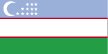
| Country name | conventional long form: Republic of Uzbekistan conventional short form: Uzbekistan local long form: O'zbekiston Respublikasi local short form: O'zbekiston former: Uzbek Soviet Socialist Republic etymology: a combination of the Turkic words "uz" (self) and "bek" (master) with the Persian suffix "-stan" (country) to give the meaning "Land of the Free" |
| Government type | presidential republic; highly authoritarian |
| Capital | name: Tashkent (Toshkent) geographic coordinates: 41 19 N, 69 15 E time difference: UTC+5 (10 hours ahead of Washington, DC, during Standard Time) etymology: "tash" means "stone" and "kent" means "city" in Turkic languages, so the name simply denotes "stone city" |
| Administrative divisions | 12 provinces (viloyatlar, singular - viloyat), 1 autonomous republic* (avtonom respublikasi), and 1 city** (shahar); Andijon Viloyati, Buxoro Viloyati [Bukhara Province], Farg'ona Viloyati [Fergana Province], Jizzax Viloyati, Namangan Viloyati, Navoiy Viloyati, Qashqadaryo Viloyati (Qarshi), Qoraqalpog'iston Respublikasi [Karakalpakstan Republic]* (Nukus), Samarqand Viloyati [Samarkand Province], Sirdaryo Viloyati (Guliston), Surxondaryo Viloyati (Termiz), Toshkent Shahri [Tashkent City]**, Toshkent Viloyati [Tashkent Province], Xorazm Viloyati (Urganch) note: administrative divisions have the same names as their administrative centers (exceptions have the administrative center name following in parentheses) |
| Independence | 1 September 1991 (from the Soviet Union) |
| National holiday | Independence Day, 1 September (1991) |
| Constitution | history: several previous; latest adopted 8 December 1992 amendments: proposed by the Supreme Assembly or by referendum; passage requires two-thirds majority vote of both houses of the Assembly or passage in a referendum; amended several times, last in 2017 |
| Legal system | civil law system; note - in early 2020, the president signed an amendment to the criminal code, criminal procedure code, and code of administrative responsibility |
| International law organization participation | has not submitted an ICJ jurisdiction declaration; non-party state to the ICCt |
| Citizenship | citizenship by birth: no citizenship by descent only: at least one parent must be a citizen of Uzbekistan dual citizenship recognized: no residency requirement for naturalization: 5 years |
| Suffrage | 18 years of age; universal |
| Executive branch | chief of state: President Shavkat MIRZIYOYEV (interim president from 8 September 2016; formally elected president on 4 December 2016 to succeed longtime President Islom KARIMOV, who died on 2 September 2016) head of government: Prime Minister Abdulla ARIPOV (since 14 December 2016); First Deputy Prime Minister/Minister of Transport Achilbay RAMATOV (since 15 December 2016) cabinet: Cabinet of Ministers appointed by the president with most requiring approval of the Senate chamber of the Supreme Assembly (Oliy Majlis) elections/appointments: president directly elected by absolute majority popular vote in 2 rounds if needed for a 5-year term (eligible for a second term; previously a 5-year term, extended by a 2002 constitutional amendment to 7 years, and reverted to 5 years in 2011); election last held on 4 December 2016 (next to be held in 2021); prime minister nominated by majority party in legislature since 2011, but appointed along with the ministers and deputy ministers by the president election results: Shavkat MIRZIYOYEV elected president in first round; percent of vote - Shavkat MIRZIYOYEV (LDPU) 88.6%, Hotamjon KETMONOV (NDP) 3.7%, Narimon UMAROV (Adolat) 3.5%, Sarvar OTAMURODOV (Milliy Tiklanish/National Revival) 2.4%, other 1.8% |
| Legislative branch | description: bicameral Supreme Assembly or Oliy Majlis consists of: Senate or Senat (100 seats; 84 members indirectly elected by regional governing councils and 16 appointed by the president; members serve 5-year terms) Legislative Chamber or Qonunchilik Palatasi (150 seats; members directly elected in single-seat constituencies by absolute majority vote with a second round if needed; members serve 5-year terms) elections: Senate - last held 16-17 January 2020 (next to be held in 2025) Legislative Chamber - last held on 22 December 2019 and 5 January 2020 (next to be held in December 2024) election results: Senate - percent of vote by party - NA; seats by party - NA; composition - men 77, women 23, percent of women 23% Legislative Chamber - percent of vote by party - NA; seats by party - LDPU 53, National Revival Democratic Party 36, Adolat 24, PDP 22, Ecological Movement 15; composition - men 83, women, 17, percent of women 17% note: all parties in the Supreme Assembly support President Shavkat MIRZIYOYEV |
| Judicial branch | highest courts: Supreme Court (consists of 67 judges organized into administrative, civil, criminal, and economic sections); Constitutional Court (consists of 7 judges) judge selection and term of office: judges of the highest courts nominated by the president and confirmed by the Senate of the Oliy Majlis; judges appointed for initial 5-year term and can be reappointed for subsequent 10-year and lifetime terms subordinate courts: regional, district, city, and town courts |
| Political parties and leaders | Ecological Party of Uzbekistan (O'zbekiston Ekologik Partivasi) [Boriy ALIKHANOV] Justice (Adolat) Social Democratic Party of Uzbekistan [Narimon UMAROV] Liberal Democratic Party of Uzbekistan (O'zbekiston Liberal-Demokratik Partiyasi) or LDPU [Aktam HAITOV] National Revival Democratic Party of Uzbekistan (O'zbekiston Milliy Tiklanish Demokratik Partiyasi) [Sarvar OTAMURATOV] People's Democratic Party of Uzbekistan (Xalq Demokratik Partiyas) or PDP [Hotamjon KETMONOV] (formerly Communist Party) |
| International organization participation | ADB, CICA, CIS, EAPC, EBRD, ECO, FAO, IAEA, IBRD, ICAO, ICC (national committees), ICCt, ICRM, IDA, IDB, IFAD, IFC, IFRCS, ILO, IMF, Interpol, IOC, ISO, ITSO, ITU, MIGA, NAM, OIC, OPCW, OSCE, PFP, SCO, UN, UNCTAD, UNESCO, UNIDO, UNWTO, UPU, WCO, WFTU (NGOs), WHO, WIPO, WMO, WTO (observer) |
| Diplomatic representation in the US | chief of mission: Ambassador Javlon VAKHABOV (since 29 November 2017) chancery: 1746 Massachusetts Avenue NW, Washington, DC 20036 telephone: [1] (202) 887-5300 FAX: [1] (202) 293-6804 email address and website: info.washington@mfa.uz https://www.uzbekistan.org/ consulate(s) general: New York |
| Diplomatic representation from the US | chief of mission: Ambassador Daniel ROSENBLUM (since 24 May 2019) embassy: 3 Moyqorghon, 5th Block, Yunusobod District, 100093 Tashkent mailing address: 7110 Tashkent Place, Washington DC 20521-7110 telephone: [998] 78-120-5450 FAX: [998] 78-120-6335 email address and website: ACSTashkent@state.gov https://uz.usembassy.gov/ |
| Flag description | three equal horizontal bands of blue (top), white, and green separated by red fimbriations with a vertical, white crescent moon (closed side to the hoist) and 12 white, five-pointed stars shifted to the hoist on the top band; blue is the color of the Turkic peoples and of the sky, white signifies peace and the striving for purity in thoughts and deeds, while green represents nature and is the color of Islam; the red stripes are the vital force of all living organisms that links good and pure ideas with the eternal sky and with deeds on earth; the crescent represents Islam and the 12 stars the months and constellations of the Uzbek calendar |
| National symbol(s) | khumo (mythical bird); national colors: blue, white, red, green |
| National anthem | name: "O'zbekiston Respublikasining Davlat Madhiyasi" (National Anthem of the Republic of Uzbekistan) lyrics/music: Abdulla ARIPOV/Mutal BURHANOV note: adopted 1992; after the fall of the Soviet Union, Uzbekistan kept the music of the anthem from its time as a Soviet Republic but adopted new lyrics |
Source: CIA World Factbook
This page was last updated on September 18, 2021