| Country name | conventional long form: none conventional short form: Tuvalu local long form: none local short form: Tuvalu former: Ellice Islands etymology: "tuvalu" means "group of eight" or "eight standing together" referring to the country's eight traditionally inhabited islands |
| Government type | parliamentary democracy under a constitutional monarchy; a Commonwealth realm |
| Capital | name: Funafuti; note - the capital is an atoll of some 29 islets; administrative offices are in Vaiaku Village on Fongafale Islet geographic coordinates: 8 31 S, 179 13 E time difference: UTC+12 (17 hours ahead of Washington, DC, during Standard Time) etymology: the atoll is named after a founding ancestor chief, Funa, from the island of Samoa |
| Administrative divisions | 7 island councils and 1 town council*; Funafuti*, Nanumaga, Nanumea, Niutao, Nui, Nukufetau, Nukulaelae, Vaitupu |
| Independence | 1 October 1978 (from the UK) |
| National holiday | Independence Day, 1 October (1978) |
| Constitution | history: previous 1978 (at independence); latest effective 1 October 1986 amendments: proposed by the House of Assembly; passage requires at least two-thirds majority vote by the Assembly membership in the final reading; amended 2007, 2010, 2013; note - in 2016, the United Nations Development Program and the Tuvaluan Government initiated a review of the country's constitution, which was ongoing as of early 2021 |
| Legal system | mixed legal system of English common law and local customary law |
| International law organization participation | has not submitted an ICJ jurisdiction declaration; non-party state to the ICCt |
| Citizenship | citizenship by birth: yes citizenship by descent only: yes; for a child born abroad, at least one parent must be a citizen of Tuvalu dual citizenship recognized: yes residency requirement for naturalization: na |
| Suffrage | 18 years of age; universal |
| Executive branch | chief of state: Queen ELIZABETH II (since 6 February 1952); represented by Acting Governor General Teniku TALESI Honolulu (since 19 August 2019) head of government: Prime Minister Kausea NATANO (since 19 September 2019) cabinet: Cabinet appointed by the governor general on recommendation of the prime minister elections/appointments: the monarchy is hereditary; governor general appointed by the monarch on recommendation of the prime minister; prime minister and deputy prime minister elected by and from members of House of Assembly following parliamentary elections election results: Kausea NATANO elected prime minister by House of Assembly; House of Assembly vote count on 19 September 2019 - 10 to 6 |
| Legislative branch | description: unicameral House of Assembly or Fale I Fono (16 seats; members directly elected in single- and multi-seat constituencies by simple majority vote to serve 4-year terms) elections: last held on 9 September 2019 (next to be held on September 2023) election results: percent of vote - NA; seats - independent 16 (9 members reelected) |
| Judicial branch | highest courts: Court of Appeal (consists of the chief justice and not less than 3 appeals judges); High Court (consists of the chief justice); appeals beyond the Court of Appeal are heard by the Judicial Committee of the Privy Council (in London) judge selection and term of office: Court of Appeal judges appointed by the governor general on the advice of the Cabinet; judge tenure based on terms of appointment; High Court chief justice appointed by the governor general on the advice of the Cabinet; chief justice serves for life; other judges appointed by the governor general on the advice of the Cabinet after consultation with chief justice; judge tenure set by terms of appointment subordinate courts: magistrates' courts; island courts; land courts |
| Political parties and leaders | there are no political parties but members of parliament usually align themselves in informal groupings |
| International organization participation | ACP, ADB, AOSIS, C, FAO, IBRD, IDA, IFAD, IFRCS (observer), ILO, IMF, IMO, IOC, ITU, OPCW, PIF, Sparteca, SPC, UN, UNCTAD, UNESCO, UNIDO, UPU, WHO, WIPO, WMO |
| Diplomatic representation in the US | chief of mission: none; the Tuvalu Permanent Mission to the UN serves as the Embassy; it is headed by Samuelu LALONIU (since 21 July 2017); address: 685 Third Avenue, Suite 1104, New York, NY 10017; telephone: [1] (212) 490-0534; FAX: [1] (212) 808-4975; email: tuvalumission.un@gmail.com |
| Diplomatic representation from the US | embassy: the US does not have an embassy in Tuvalu; the US Ambassador to Fiji is accredited to Tuvalu |
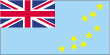
| Flag description | light blue with the flag of the UK in the upper hoist-side quadrant; the outer half of the flag represents a map of the country with nine yellow, five-pointed stars on a blue field symbolizing the nine atolls in the ocean |
| National symbol(s) | maneapa (native meeting house); national colors: light blue, yellow |
| National anthem | name: "Tuvalu mo te Atua" (Tuvalu for the Almighty) lyrics/music: Afaese MANOA note: adopted 1978; the anthem's name is also the nation's motto |
Source: CIA World Factbook
This page was last updated on September 18, 2021