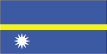
| Country name | conventional long form: Republic of Nauru conventional short form: Nauru local long form: Republic of Nauru local short form: Nauru former: Pleasant Island etymology: the island name may derive from the Nauruan word "anaoero" meaning "I go to the beach" |
| Government type | parliamentary republic |
| Capital | name: no official capital; government offices in the Yaren District time difference: UTC+12 (17 hours ahead of Washington, DC, during Standard Time) |
| Administrative divisions | 14 districts; Aiwo, Anabar, Anetan, Anibare, Baitsi, Boe, Buada, Denigomodu, Ewa, Ijuw, Meneng, Nibok, Uaboe, Yaren |
| Independence | 31 January 1968 (from the Australia-, NZ-, and UK-administered UN trusteeship) |
| National holiday | Independence Day, 31 January (1968) |
| Constitution | history: effective 29 January 1968 amendments: proposed by Parliament; passage requires two-thirds majority vote of Parliament; amendments to constitutional articles, such as the republican form of government, protection of fundamental rights and freedoms, the structure and authorities of the executive and legislative branches, also requires two-thirds majority of votes in a referendum; amended several times, last in 2018 |
| Legal system | mixed legal system of common law based on the English model and customary law |
| International law organization participation | has not submitted an ICJ jurisdiction declaration; accepts ICCt jurisdiction |
| Suffrage | 20 years of age; universal and compulsory |
| Executive branch | chief of state: President Lionel AINGIMEA (since 27 August 2019); note - the president is both chief of state and head of government head of government: President Lionel AINGIMEA (since 27 August 2019) cabinet: Cabinet appointed by the president from among members of Parliament elections/appointments: president indirectly elected by Parliament (eligible for a second term); election last held on 27 August 2019 (next to be held in 2022) election results: Lionel AINGIMEA elected president; Parliament vote - Lionel AINGIMEA (independent) 12, David ADEANG (Nauru First) 6 |
| Legislative branch | description: unicameral parliament (19 seats; members directly elected in multi-seat constituencies by majority vote using the "Dowdall" counting system by which voters rank candidates on their ballots; members serve 3-year terms) elections: last held on 24 August 2019 (next to be held in 2022) election results: percent of vote - NA; seats - independent 19; composition - men 17, women 2, percent of women 10.5% |
| Judicial branch | highest courts: Supreme Court (consists of the chief justice and several justices); note - in late 2017, the Nauruan Government revoked the 1976 High Court Appeals Act, which had allowed appeals beyond the Nauruan Supreme Court, and in early 2018, the government formed its own appeals court judge selection and term of office: judges appointed by the president to serve until age 65 subordinate courts: District Court, Family Court |
| Political parties and leaders | Nauru First (Naoero Amo) Party [David ADEANG] |
| International organization participation | ACP, ADB, AOSIS, C, FAO, G-77, ICAO, ICCt, IFAD, Interpol, IOC, IOM, ITU, OPCW, PIF, Sparteca, SPC, UN, UNCTAD, UNESCO, UPU, WHO |
| Diplomatic representation in the US | chief of mission: Ambassador Marlene Inemwin MOSES (since 13 March 2006) chancery: 800 2nd Avenue, Third Floor, New York, NY 10017 telephone: [1] (212) 937-0074 FAX: [1] (212) 937-0079 email address and website: nauru@onecommonwealth.org https://www.un.int/nauru/ |
| Diplomatic representation from the US | embassy: the US does not have an embassy in Nauru; the US Ambassador to Fiji is accredited to Nauru |
| Flag description | blue with a narrow, horizontal, gold stripe across the center and a large white 12-pointed star below the stripe on the hoist side; blue stands for the Pacific Ocean, the star indicates the country's location in relation to the Equator (the gold stripe) and the 12 points symbolize the 12 original tribes of Nauru; the star's white color represents phosphate, the basis of the island's wealth |
| National symbol(s) | frigatebird, calophyllum flower; national colors: blue, yellow, white |
| National anthem | name: "Nauru Bwiema" (Song of Nauru) lyrics/music: Margaret HENDRIE/Laurence Henry HICKS note: adopted 1968 |
Source: CIA World Factbook
This page was last updated on September 18, 2021