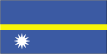
| Location | Oceania, island in the South Pacific Ocean, south of the Marshall Islands |
| Geographic coordinates | 0 32 S, 166 55 E |
| Map references | Oceania |
| Area | total: 21 sq km land: 21 sq km water: 0 sq km |
| Area - comparative | about 0.1 times the size of Washington, DC |
| Land boundaries | total: 0 km |
| Coastline | 30 km |
| Maritime claims | territorial sea: 12 nm contiguous zone: 24 nm exclusive economic zone: 200 nm |
| Climate | tropical with a monsoonal pattern; rainy season (November to February) |
| Terrain | sandy beach rises to fertile ring around raised coral reefs with phosphate plateau in center |
| Elevation extremes | highest point: Command Ridge 70 m lowest point: Pacific Ocean 0 m |
| Natural resources | phosphates, fish |
| Land use | agricultural land: 20% (2018 est.) arable land: 0% (2018 est.) permanent crops: 20% (2018 est.) permanent pasture: 0% (2018 est.) forest: 0% (2018 est.) other: 80% (2018 est.) |
| Irrigated land | 0 sq km (2012) |
| Total renewable water resources | 10 million cubic meters (2017 est.) |
| Natural hazards | periodic droughts |
| Geography - note | Nauru is the third-smallest country in the world behind the Holy See (Vatican City) and Monaco; it is the smallest country in the Pacific Ocean, the smallest country outside Europe, the world's smallest island country, and the the world's smallest independent republic; situated just 53 km south of the Equator, Nauru is one of the three great phosphate rock islands in the Pacific Ocean - the others are Banaba (Ocean Island) in Kiribati and Makatea in French Polynesia |
Source: CIA World Factbook
This page was last updated on September 18, 2021