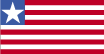
| Location | Western Africa, bordering the North Atlantic Ocean, between Cote d'Ivoire and Sierra Leone |
| Geographic coordinates | 6 30 N, 9 30 W |
| Map references | Africa |
| Area | total: 111,369 sq km land: 96,320 sq km water: 15,049 sq km |
| Area - comparative | slightly larger than Virginia |
| Land boundaries | total: 1,667 km border countries (3): Guinea 590 km, Cote d'Ivoire 778 km, Sierra Leone 299 km |
| Coastline | 579 km |
| Maritime claims | territorial sea: 12 nm contiguous zone: 24 nm exclusive economic zone: 200 nm continental shelf: 200 nm |
| Climate | tropical; hot, humid; dry winters with hot days and cool to cold nights; wet, cloudy summers with frequent heavy showers |
| Terrain | mostly flat to rolling coastal plains rising to rolling plateau and low mountains in northeast |
| Elevation extremes | highest point: Mount Wuteve 1,447 m lowest point: Atlantic Ocean 0 m mean elevation: 243 m |
| Natural resources | iron ore, timber, diamonds, gold, hydropower |
| Land use | agricultural land: 28.1% (2018 est.) arable land: 5.2% (2018 est.) permanent crops: 2.1% (2018 est.) permanent pasture: 20.8% (2018 est.) forest: 44.6% (2018 est.) other: 27.3% (2018 est.) |
| Irrigated land | 30 sq km (2012) |
| Total renewable water resources | 232 billion cubic meters (2017 est.) |
| Natural hazards | dust-laden harmattan winds blow from the Sahara (December to March) |
| Geography - note | facing the Atlantic Ocean, the coastline is characterized by lagoons, mangrove swamps, and river-deposited sandbars; the inland grassy plateau supports limited agriculture |
Source: CIA World Factbook
This page was last updated on September 18, 2021