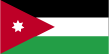
| Location | Middle East, northwest of Saudi Arabia, between Israel (to the west) and Iraq |
| Geographic coordinates | 31 00 N, 36 00 E |
| Map references | Middle East |
| Area | total: 89,342 sq km land: 88,802 sq km water: 540 sq km |
| Area - comparative | about three-quarters the size of Pennsylvania; slightly smaller than Indiana |
| Land boundaries | total: 1,744 km border countries (5): Iraq 179 km, Israel 307 km, Saudi Arabia 731 km, Syria 379 km, West Bank 148 km |
| Coastline | 26 km |
| Maritime claims | territorial sea: 3 nm |
| Climate | mostly arid desert; rainy season in west (November to April) |
| Terrain | mostly arid desert plateau; a great north-south geological rift along the west of the country is the dominant topographical feature and includes the Jordan River Valley, the Dead Sea, and the Jordanian Highlands |
| Elevation extremes | highest point: Jabal Umm ad Dami 1,854 m lowest point: Dead Sea -431 m mean elevation: 812 m |
| Natural resources | phosphates, potash, shale oil |
| Land use | agricultural land: 11.4% (2018 est.) arable land: 2% (2018 est.) permanent crops: 1% (2018 est.) permanent pasture: 8.4% (2018 est.) forest: 1.1% (2018 est.) other: 87.5% (2018 est.) |
| Irrigated land | 964 sq km (2012) |
| Total renewable water resources | 937 million cubic meters (2017 est.) |
| Natural hazards | droughts; periodic earthquakes; flash floods |
| Geography - note | strategic location at the head of the Gulf of Aqaba and as the Arab country that shares the longest border with Israel and the occupied West Bank; the Dead Sea, the lowest point in Asia and the second saltiest body of water in the world (after Lac Assal in Djibouti), lies on Jordan's western border with Israel and the West Bank; Jordan is almost landlocked but does have a 26 km southwestern coastline with a single port, Al 'Aqabah (Aqaba) |
Source: CIA World Factbook
This page was last updated on September 18, 2021