| Country name | conventional long form: none conventional short form: Bosnia and Herzegovina local long form: none local short form: Bosna i Hercegovina former: People's Republic of Bosnia and Herzegovina, Socialist Republic of Bosnia and Herzegovina abbreviation: BiH etymology: the larger northern territory is named for the Bosna River; the smaller southern section takes its name from the German word "herzog," meaning "duke," and the ending "-ovina," meaning "land," forming the combination denoting "dukedom" |
| Government type | parliamentary republic |
| Capital | name: Sarajevo geographic coordinates: 43 52 N, 18 25 E time difference: UTC+1 (6 hours ahead of Washington, DC, during Standard Time) daylight saving time: +1hr, begins last Sunday in March; ends last Sunday in October etymology: the name derives from the Turkish noun "saray," meaning "palace" or "mansion," and the term "ova," signifying "plain(s)," to give a meaning of "palace plains" or "the plains about the palace" |
| Administrative divisions | 3 first-order administrative divisions - Brcko District (Brcko Distrikt) (ethnically mixed), Federation of Bosnia and Herzegovina (Federacija Bosne i Hercegovine) (predominantly Bosniak-Croat), Republika Srpska (predominantly Serb) |
| Independence | 1 March 1992 (from Yugoslavia); note - referendum for independence completed on 1 March 1992; independence declared on 3 March 1992 |
| National holiday | Independence Day, 1 March (1992) and Statehood Day, 25 November (1943) - both observed in the Federation of Bosnia and Herzegovina entity; Victory Day, 9 May (1945) and Dayton Agreement Day, 21 November (1995) - both observed in the Republika Srpska entity note: there is no national-level holiday |
| Constitution | history: 14 December 1995 (constitution included as part of the Dayton Peace Accords); note - each of the political entities has its own constitution amendments: decided by the Parliamentary Assembly, including a two-thirds majority vote of members present in the House of Representatives; the constitutional article on human rights and fundamental freedoms cannot be amended; amended several times, last in 2009 |
| Legal system | civil law system; Constitutional Court review of legislative acts |
| International law organization participation | has not submitted an ICJ jurisdiction declaration; accepts ICCt jurisdiction |
| Citizenship | citizenship by birth: no citizenship by descent only: at least one parent must be a citizen of Bosnia and Herzegovina dual citizenship recognized: yes, provided there is a bilateral agreement with the other state residency requirement for naturalization: 8 years |
| Suffrage | 18 years of age, 16 if employed; universal |
| Executive branch | chief of state: Chairman of the Presidency Zeljko KOMSIC (chairman since 20 July 2021; presidency member since 20 November 2018 - Croat seat); Sefik DZAFEROVIC (presidency member since 20 November 2018 - Bosniak seat); Milorad DODIK (presidency member since 20 November 2018 - Serb seat) head of government: Chairman of the Council of Ministers Zoran TEGELTIJA (since 5 December 2019) cabinet: Council of Ministers nominated by the council chairman, approved by the state-level House of Representatives elections/appointments: 3-member presidency (1 Bosniak and 1 Croat elected from the Federation of Bosnia and Herzegovina and 1 Serb elected from the Republika Srpska) directly elected by simple majority popular vote for a 4-year term (eligible for a second term, but then ineligible for 4 years); the presidency chairpersonship rotates every 8 months with the new member of the presidency elected with the highest number of votes starting the new mandate as chair; election last held on 7 October 2018 (next to be held in October 2022); the chairman of the Council of Ministers appointed by the presidency and confirmed by the state-level House of Representatives election results: percent of vote - Milorad DODIK (SNSD) 53.9% - Serb seat; Zeljko KOMSIC (DF) 52.6% - Croat seat; Sefik DZAFEROVIC (SDA) 36.6% - Bosniak seat note: President of the Federation of Bosnia and Herzegovina Marinko CAVARA (since 11 February 2015); Vice Presidents Melika MAHMUTBEGOVIC (since 11 February 2015), Milan DUNOVIC (since 11 February 2015); President of the Republika Srpska Zeljka CVIJANOVIC (since 18 November 2018); Vice Presidents Ramiz SALKIC (since 24 November 2014), Josip JERKOVIC (since 24 November 2014) |
| Legislative branch | description: bicameral Parliamentary Assembly or Skupstina consists of: House of Peoples or Dom Naroda (15 seats - 5 Bosniak, 5 Croat, 5 Serb; members designated by the Federation of Bosnia and Herzegovina's House of Peoples and the Republika Srpska's National Assembly to serve 4-year terms) House of Representatives or Predstavnicki Dom (42 seats to include 28 seats allocated to the Federation of Bosnia and Herzegovina and 14 to the Republika Srpska; members directly elected by proportional representation vote to serve 4-year terms); note - the Federation of Bosnia and Herzegovina has a bicameral legislature that consists of the House of Peoples (58 seats - 17 Bosniak, 17 Croat, 17 Serb, 7 other) and the House of Representatives (98 seats; members directly elected by proportional representation vote to serve 4-year terms); Republika Srpska's unicameral legislature is the National Assembly (83 directly elected delegates serve 4-year terms) elections: House of Peoples - last held on 18 October 2018 (next to be held in October 2022) House of Representatives - last held on 7 October 2018 (next to be held in October 2022) election results: House of Peoples - percent of vote by coalition/party - NA; seats by coalition/party - NA; composition - men 13, women 2, percent of women 13.3% House of Representatives - percent of vote by coalition/party - SDA 17%, SNSD 16%, SDS/NDP/NS/SRS-VS 9.8%, SDP 9.1%, HDZ-BiH/HSS/HKDU/HSP-AS BiH/HDU BiH 9.1%, DF, 5.8%, PDP 5.1%, DNS 4.2%, SBB BiH 4.2%, NS/HC 2.9%, NB 2.5%, PDA 2.3%, SP 1.9%, A-SDA 1.8%, other 17.4%; seats by coalition/party - SDA 9, SNSD 6, SDP 5, HDZ-BiH/HSS/HKDU/HSP-AS BiH/HDU BiH 5, SDS/NDP/NS/SRS-VS 3, DF 3, PDP 2, SBB BiH 2, NS/HC 2, DNS 1, NB 1 PDA 1, SP 1, A-SDA 1; composition - men 33, women 9, percent of women 21.4%; note - total Parliamentary Assembly percent of women 19.3% |
| Judicial branch | highest courts: Bosnia and Herzegovina (BiH) Constitutional Court (consists of 9 members); Court of BiH (consists of 44 national judges and 7 international judges organized into 3 divisions - Administrative, Appellate, and Criminal, which includes a War Crimes Chamber) judge selection and term of office: BiH Constitutional Court judges - 4 selected by the Federation of Bosnia and Herzegovina House of Representatives, 2 selected by the Republika Srpska's National Assembly, and 3 non-Bosnian judges selected by the president of the European Court of Human Rights; Court of BiH president and national judges appointed by the High Judicial and Prosecutorial Council; Court of BiH president appointed for renewable 6-year term; other national judges appointed to serve until age 70; international judges recommended by the president of the Court of BiH and appointed by the High Representative for Bosnia and Herzegovina; international judges appointed to serve until age 70 subordinate courts: the Federation has 10 cantonal courts plus a number of municipal courts; the Republika Srpska has a supreme court, 5 district courts, and a number of municipal courts |
| Political parties and leaders | Alliance for a Better Future of BiH or SBB BiH [Fahrudin RADONCIC] Alliance of Independent Social Democrats or SNSD [Milorad DODIK] Alternative Party for Democratic Activity or A-SDA [Nermin OGRESEVIC] Croat Peasants' Party or HSS [Mario KARAMATIC] Croatian Christian Democratic Union of Bosnia and Herzegovina or HKDU [Ivan MUSA] Croatian Democratic Union of Bosnia and Herzegovina or HDU-BiH [Miro GRABOVAC-TITAN] Croatian Democratic Union of Bosnia and Herzegovina or HDZ-BiH [Dragan COVIC] Croatian Democratic Union 1990 or HDZ-1990 [Ilija CVITANOVIC] Croatian Party of Rights dr. Ante Starcevic or HSP-AS Bih [Karlo STARCEVIC] Democratic Alliance or DEMOS [Nedeljko CUBRILOVIC] Democratic Front of DF [Zeljko KOMSIC] Democratic Peoples' Alliance or DNS [Marko PAVIC] Independent Bloc or NB [Senad SEPIC] Movement for Democratic Action or PDA [Mirsad KUKIC] Progressive Srpska or NS [Goran DORDIC] Our Party or NS/HC [Predrag KOJOVIC] Party for Democratic Action or SDA [Bakir IZETBEGOVIC] Party of Democratic Progress or PDP [Branislav BORENOVIC] People's Democratic Movement or NDP [Dragan CAVIC] Serb Democratic Party or SDS [Vukota GOVEDARICA] Serb Radical Party-Dr. Vojislav Seselj or SRS-VS [Vojislav SESELJ] (members joined the PDP) Social Democratic Party or SDP [Nermin NIKSIC] Socialist Party or SP [Petar DOKIC] United Srpska or US [Nenad STEVANDIC] |
| International organization participation | BIS, CD, CE, CEI, EAPC, EBRD, FAO, G-77, IAEA, IBRD, ICAO, ICC (NGOs), ICCt, ICRM, IDA, IFAD, IFC, IFRCS, ILO, IMF, IMO, IMSO, Interpol, IOC, IOM, IPU, ISO, ITSO, ITU, ITUC (NGOs), MIGA, MINUSMA, MONUSCO, NAM (observer), OAS (observer), OIC (observer), OIF (observer), OPCW, OSCE, PFP, SELEC, UN, UNCTAD, UNESCO, UNIDO, UNWTO, UPU, WCO, WHO, WIPO, WMO, WTO (observer) |
| Diplomatic representation in the US | chief of mission: Ambassador Bojan VUJIC (since 16 September 2019) chancery: 2109 E Street NW, Washington, DC 20037 telephone: [1] (202) 337-1500 FAX: [1] (202) 337-1502 email address and website: consularaffairs@bhembassy; info@bhembassy.org http://www.bhembassy.org/index.html consulate(s) general: Chicago, New York |
| Diplomatic representation from the US | chief of mission: Ambassador Eric NELSON (since 19 February 2019) embassy: 1 Robert C. Frasure Street, 71000 Sarajevo mailing address: 7130 Sarajevo Place, Washington DC 20521-7130 telephone: [387] (33) 704-000 FAX: [387] (33) 659-722 email address and website: sarajevoACS@state.gov https://ba.usembassy.gov/ branch office(s): Banja Luka, Mostar |
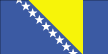
| Flag description | a wide blue vertical band on the fly side with a yellow isosceles triangle abutting the band and the top of the flag; the remainder of the flag is blue with seven full five-pointed white stars and two half stars top and bottom along the hypotenuse of the triangle; the triangle approximates the shape of the country and its three points stand for the constituent peoples - Bosniaks, Croats, and Serbs; the stars represent Europe and are meant to be continuous (thus the half stars at top and bottom); the colors (white, blue, and yellow) are often associated with neutrality and peace, and traditionally are linked with Bosnia note: one of several flags where a prominent component of the design reflects the shape of the country; other such flags are those of Brazil, Eritrea, and Vanuatu |
| National symbol(s) | golden lily; national colors: blue, yellow, white |
| National anthem | name: "Drzavna himna Bosne i Hercegovine" (The National Anthem of Bosnia and Herzegovina) lyrics/music: none officially; Dusan SESTIC and Benjamin ISOVIC/Dusan SESTIC note: music adopted 1999; lyrics proposed in 2009 and others in 2016 were not approved; a parliamentary committee launched a new initiative for lyrics in February 2018 |
Source: CIA World Factbook
This page was last updated on September 18, 2021